

A laboratory result above an environmental standard will usually attract immediate attention. But does it always mean that activities at the monitored site have caused an environmental impact?
Not necessarily.
Some substances occur naturally in soil, groundwater and surface water. Others may already be present because of regional land uses, historical activities or sources outside the site being assessed. In these situations, a result can be higher than a generic environmental standard while remaining consistent with the concentration entering the site or normally found in the surrounding area.
ESdat is introducing support for site background concentrations so users can incorporate this context when calculating trigger levels and flagging exceedances.
What is a background concentration?
A background concentration represents the concentration of a substance that would be expected in the absence of the site-related impact being assessed.
Depending on the monitoring program and applicable regulatory framework, this may mean:
- a naturally occurring concentration associated with local geology or soil;
- an ambient concentration that includes widespread, diffuse influences;
- the concentration in water entering a site from an upgradient or upstream location;
- a baseline established before an activity commenced; or
- a reference concentration obtained from a comparable, unaffected location.
These concepts are related but are not always interchangeable. For example, an upgradient groundwater bore may represent water entering a site, but it does not automatically represent a purely natural concentration. It may already be influenced by regional development, agriculture, industry or another off-site source.
Terminology and acceptable methods vary between jurisdictions. The Australian National Environment Protection Measure, for example, uses the term ambient background concentration when deriving certain ecological investigation levels. It prefers measurement at an appropriate reference site where possible and recognises that naturally occurring concentrations of metals can vary substantially with parent geology. See the NEPC Guideline on Investigation Levels for Soil and Groundwater.
The important question is not simply, “What is the background concentration?” It is: “What reference condition is appropriate for this site, this substance, this environmental medium and this decision?”
Why environmental standards may not tell the whole story
Environmental standards, criteria and action levels provide essential benchmarks for protecting human health, ecosystems and environmental values. They help identify results that require attention and create consistency across monitoring and assessment programs.
However, many criteria are generic. They may not reflect local geology, groundwater chemistry, upstream water quality or the historical condition of a particular site.
A simple groundwater example
Consider a groundwater monitoring program in an area where arsenic occurs naturally in the aquifer. If the applicable environmental criterion is 0.010 mg/L, but groundwater entering the site consistently contains approximately 0.015 mg/L, results close to the natural or incoming concentration could repeatedly be flagged against the generic criterion.
Those flags remain relevant: the environmental criterion has still been exceeded. However, the comparison does not, by itself, demonstrate that the monitored facility caused the elevated concentration.
Treating every such result as a new site-related exceedance can:
- generate repeated false alarms about site performance;
- obscure genuine changes in environmental conditions;
- divert attention from emerging trends;
- create unnecessary investigation and reporting work; and
- make it harder to distinguish regional conditions from site-related impacts.
A background-informed trigger can provide a more meaningful operational test. Under one possible framework, a result must exceed both the applicable environmental criterion and an appropriately derived background threshold before it is classified as an operational exceedance requiring a defined response.
This does not make the environmental standard irrelevant. It adds context to the interpretation and preserves the distinction between exceeding a criterion and demonstrating a site-related impact.
When should background concentrations be used?
Background concentrations may be particularly useful where:
- metals or metalloids occur naturally at elevated concentrations;
- groundwater chemistry is strongly influenced by local geology;
- salinity, nutrients or other parameters vary naturally or seasonally;
- upstream or upgradient water is already affected before reaching the site;
- a long-running monitoring program has sufficient historical reference data;
- a licence, approval, management plan or trigger-action-response plan expressly incorporates background conditions; or
- a site-specific criterion is intended to distinguish site-related change from existing conditions.
These situations can arise in contaminated-land assessments, groundwater monitoring, landfill programs, mining operations, industrial facilities and surface-water monitoring.
Background comparisons can also form part of a tiered response framework. For example, an early-warning trigger may identify a rising trend, an alert level may show that a result is approaching an objective, and an action trigger may indicate that an approved threshold has been exceeded. EPA Victoria provides examples of this type of trigger-action-response approach.
When is a background adjustment not appropriate?
A background value should not be adopted merely because it produces fewer exceedance flags.
It may be inappropriate where:
- the selected reference location may be affected by the site;
- upgradient and downgradient locations monitor different aquifers or geological units;
- the reference and assessment locations are not otherwise comparable;
- the historical dataset is too small, inconsistent or unrepresentative;
- sampling or analytical methods have changed without suitable reconciliation;
- the apparent background includes a localised source that should be separately investigated;
- the applicable standard is an absolute limit that does not permit adjustment; or
- the regulator, approval or monitoring plan requires all criterion exceedances to be reported.
Background also does not replace risk assessment. A concentration consistent with natural background may still present a risk to a particular environmental value or use. Conversely, a result below both background and a generic criterion may still warrant attention if it represents a significant and persistent upward trend.
How is a defensible background concentration established?
A defensible background value begins with the conceptual site model, not with a statistical calculation.
1. Define the purpose
The monitoring program should specify what the background value is intended to represent. Is it natural background, ambient regional conditions, the quality of water entering the site, or a pre-development baseline?
The answer determines which locations, sampling periods and results should be included.
2. Select representative reference locations
Reference locations should be demonstrably outside the influence of the source being assessed while remaining comparable to the monitored site.
For groundwater, this commonly means identifying genuinely upgradient bores within the same aquifer or hydrostratigraphic unit. Groundwater direction can change over time, so a bore labelled “upgradient” should not be accepted without considering water levels, seasonal conditions, pumping and local hydrogeology.
For surface water, suitable upstream locations should be outside the site’s influence and account for tributaries, discharges and catchment changes.
For soil, reference areas should have comparable geology, soil type and land-use history. EPA Victoria’s Background Levels Methodology Guidance recommends identifying suitable reference sites and using multiple lines of evidence rather than relying on concentration data alone.
3. Assemble suitable data
The dataset should be sufficiently representative of normal variability. Relevant considerations include:
- the number and frequency of samples;
- seasonal and climatic variation;
- changes in groundwater level or flow direction;
- laboratory methods and limits of reporting;
- the treatment of non-detect results;
- sampling and quality-control records;
- outliers and anomalous events; and
- changes in site or surrounding land use.
More data are not automatically better. A large dataset containing unrepresentative locations or periods can produce a less defensible value than a smaller, carefully selected dataset.
4. Choose and document the calculation
A background concentration may be adopted as a fixed value or calculated statistically from reference data. Possible approaches include a specified percentile, an upper confidence limit, a prediction limit or another method required by the applicable framework.
The correct method depends on the purpose, data distribution, sample size and regulatory requirements. It should be selected by a suitably qualified environmental professional and documented in the monitoring plan.
5. Review the value periodically
Background is not necessarily static. It may change because of climate, groundwater movement, regional land use or improved information.
A calculated background threshold should therefore be reviewed periodically and when:
- new reference data become available;
- monitoring locations change;
- site operations materially change;
- an unusual event affects the reference dataset; or
- regulatory requirements are updated.
From background concentration to trigger level
The relationship between an environmental standard and a background concentration must be explicitly defined.
In a simple dual-threshold arrangement, an operational exceedance might be flagged only when:
Result > Environmental Standard
and
Result > Background Concentration
This can also be expressed as:
Trigger Level = the greater of the Environmental Standard or Background Concentration
This is not the only possible method. Some regulatory frameworks use background as one component of a calculated criterion. For example, certain ecological investigation levels are derived as follows:
Ecological Investigation Level = Ambient Background Concentration + Added Contaminant Limit
Other programs may use percentiles, confidence limits, prediction limits, seasonal thresholds or tiered alert levels. The calculation should reflect the approved assessment methodology. It should not be chosen solely as a convenient way to suppress flags.
Preserving the meaning of each comparison
It is good practice to retain the separate comparisons rather than showing only one red-or-green outcome.
| Comparison outcome | Possible interpretation |
|---|---|
| Result exceeds neither value | No threshold exceedance is indicated. |
| Result exceeds background but not the environmental standard | Conditions may have changed relative to the reference condition, although the environmental criterion has not been exceeded. |
| Result exceeds the environmental standard but remains within background | The generic criterion is exceeded, but the result may still be consistent with the adopted reference condition. |
| Result exceeds both values | The result meets the dual-threshold definition of an operational exceedance and may require the specified response. |
Bringing background-aware exceedances into ESdat
ESdat is environmental data management software for scientists, engineers, consultants, site operators and regulators. It brings together information from laboratories, field programs, data loggers, sensors, historical datasets and regulatory standards. Users can analyse and communicate the data through tables, graphs, maps, notifications and quality-control tools.
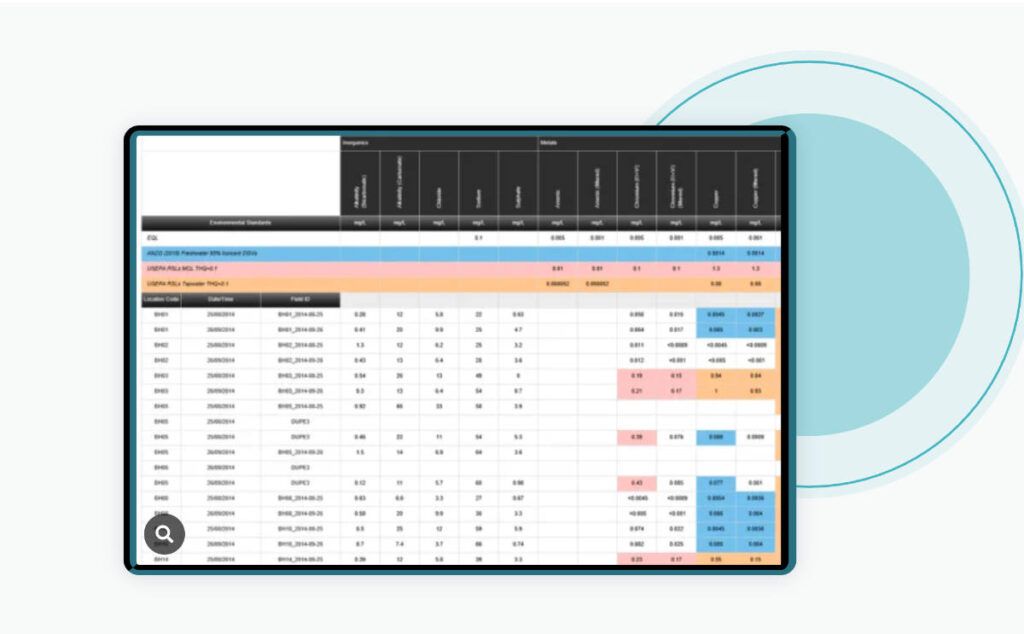
ESdat already supports comparisons between analytical results and environmental standards, including chemistry exceedance tables and exceedance notifications. The forthcoming background-concentration functionality will extend those comparisons by allowing site background or reference values to be incorporated into trigger calculations.
Users will be able to define a background concentration as either:
- a fixed value; or
- a formula calculated from historical results at nominated upstream, upgradient or other reference locations.
This means a result can be checked against both the relevant Environmental Standard or Action Level and the applicable Background Concentration before being flagged as an exceedance.
Where a calculated value is used, the trigger can reflect the selected body of historical reference data rather than relying on a single manually maintained number. This can be particularly valuable for long-running monitoring programs in which background conditions vary over time.
The configuration and calculation method still need appropriate professional and regulatory approval. ESdat provides the mechanism for applying the decision rule consistently; it does not determine which scientific or regulatory method is appropriate for a particular site.
Why this capability matters
Background-informed calculations are often performed manually in spreadsheets or explained after exceedance tables have already been produced. This creates additional work and can separate the interpretation from the underlying data.
Bringing the calculation into ESdat can help organisations:
- apply an agreed method consistently across monitoring rounds;
- reduce manual calculations and transcription risk;
- make better use of historical reference data;
- identify potentially site-related changes sooner;
- avoid repeatedly escalating results that reflect established background conditions;
- produce clearer exceedance tables and reports; and
- maintain a more transparent and reproducible assessment process.
The greatest benefit is not simply fewer exceedance flags. It is better flags: flags that reflect the monitoring program’s actual decision rules and direct attention to results most likely to require investigation or action.
Implementation checklist
Before configuring background concentrations in an environmental data management system, document:
- what “background” means for the monitoring program;
- which locations, environmental media and data periods represent it;
- why the reference data are comparable to the assessment locations;
- how the fixed value or formula is calculated;
- how non-detects, outliers and anomalous events are handled;
- the minimum data requirements for the calculation;
- how often the value or formula will be reviewed;
- what each comparison outcome triggers;
- which results must still be reported regardless of background; and
- who is authorised to approve or change the configuration.
With these decisions in place, ESdat’s new functionality can turn a potentially complex and repetitive assessment into a consistent, traceable workflow. This can help environmental professionals move from simply finding numbers above a standard to understanding whether those numbers indicate a meaningful change.
Frequently asked questions
Does a result above an environmental standard always count as an exceedance?
It is an exceedance of that standard in the literal comparison. Whether it is also classified as an operational, compliance or site-related exceedance depends on the applicable licence, approval, monitoring plan and decision rules. Some frameworks require a result to exceed both a standard and an approved background threshold before a particular action is triggered.
Does being below background mean that a result is safe?
No. Background and risk answer different questions. A naturally occurring or ambient concentration can still pose a risk to human health, ecosystems or a particular use of groundwater or surface water. Risk must be assessed against the relevant environmental values and exposure pathways.
Is an upgradient bore automatically a valid background bore?
No. The bore should monitor the same relevant aquifer or hydrostratigraphic unit, remain outside the site’s influence and be representative of water entering the site. Groundwater gradients, seasonal changes, pumping and possible off-site sources should also be considered.
Can a single sample be used as the background concentration?
A single measurement rarely characterises temporal variability reliably. Whether it is acceptable depends on the purpose and applicable guidance, but a defensible calculated background value will generally require a representative dataset and supporting lines of evidence.
Should background be a fixed value or a calculated value?
A fixed value may be appropriate when an approved site-specific threshold has already been established. A calculated value may be preferable when the monitoring framework requires background to be derived from an evolving historical reference dataset. The choice should be documented and approved.
What statistical method should be used to calculate background?
There is no universal method. Depending on the regulatory framework and dataset, the calculation could use a percentile, confidence limit, prediction limit or another prescribed statistic. Sample size, data distribution, seasonality, non-detects and outliers all affect the choice. A suitably qualified professional should select and document the method.
Can background concentrations change over time?
Yes. Natural variability, rainfall, drought, groundwater movement, regional land-use change and additional monitoring information can alter the estimated background condition. Background calculations and their source datasets should therefore be reviewed periodically.
Will ESdat decide whether a background-adjusted trigger is legally acceptable?
No. ESdat can store and apply the configured values and formulas consistently. The user remains responsible for ensuring that the method is scientifically appropriate and consistent with the relevant environmental standard, approval, licence, regulator guidance and reporting obligations.
What is the advantage of calculating background within ESdat?
It connects the trigger calculation directly to controlled environmental data, reduces repetitive spreadsheet work and applies the approved rule consistently across monitoring results. It can also make the basis of an exceedance easier to review and reproduce.
Glossary
- Action Level
- A concentration or condition that initiates a predefined investigation, notification, management or corrective action.
- Added Contaminant Limit (ACL)
- The amount of a contaminant that may be added to an ambient background concentration when deriving certain ecological investigation levels under a specified methodology.
- Ambient Background Concentration (ABC)
- The concentration present in the surrounding environment, potentially reflecting natural sources and widespread diffuse influences. Its precise meaning depends on the applicable framework.
- Background Concentration
- A reference concentration expected in the absence of the site-related impact being assessed. It may represent natural, ambient, upstream, upgradient or baseline conditions, depending on the monitoring program.
- Baseline
- Conditions measured during a defined reference period, often before a new activity or development begins. Baseline is time-based and is not necessarily the same as natural background.
- Conceptual Site Model (CSM)
- A representation of the site that brings together potential sources, environmental media, transport pathways, receptors and relevant physical conditions. It guides monitoring design and interpretation.
- Environmental Standard
- A guideline, criterion, objective, limit or other benchmark used to assess environmental data. Its legal and technical status depends on the source and context in which it is applied.
- Exceedance
- A result above a specified comparison value. The consequences of an exceedance depend on whether the value is a screening criterion, trigger, objective, licence limit or another type of benchmark.
- Fixed Background Value
- A predetermined background concentration stored and used as a constant until it is formally reviewed or replaced.
- Historical Reference Data
- Results collected over time from locations or periods selected to represent the relevant reference condition.
- Hydrostratigraphic Unit
- A body of rock or sediment grouped according to its groundwater-flow characteristics. Bores in different units may not provide valid comparisons.
- Limit of Reporting (LOR)
- The lowest concentration a laboratory reports quantitatively for a particular analytical method and sample.
- Non-detect
- A result for which the substance was not reported at or above the relevant detection or reporting limit. Non-detects require an appropriate treatment in statistical calculations.
- Reference Location
- A location selected to represent conditions outside the influence of the site-related source being assessed while remaining suitably comparable to the monitored location.
- Trigger Level
- A defined value or condition that initiates a specified response. It may be a fixed number or a value calculated from an environmental standard, background data or another approved rule.
- Trigger Action Response Plan (TARP)
- A documented framework linking monitoring triggers to defined actions, responsibilities, timeframes and escalation steps.
- Upgradient or Upstream Location
- A monitoring location positioned before the assessed site in the direction of groundwater flow or surface-water flow. It must still be assessed for representativeness and potential external influences.
This article provides general educational information. The selection and application of background concentrations should be undertaken by suitably qualified professionals in accordance with the relevant jurisdiction, approval conditions and monitoring framework.
Related Articles
What is exceedance? Definition, Explanation and Example.
Environmental Compliance Software for Monitoring Data and Reporting
What Environmental Data Management Skills Do Environmental Scientists Need
Top Providers of Environmental Data Management Software for Enterprises