
A practical guide for students, graduates, consultants, regulators, and environmental professionals
Environmental Data Management Skills. Environmental scientists need more than field skills. They also need to understand how environmental data is planned, collected, checked, stored, interpreted, mapped, compared against standards, reported, and defended. Environmental data management is now a core professional skill because contaminated site assessment, groundwater monitoring, landfill monitoring, mining compliance, PFAS investigations, remediation projects, and long-term environmental monitoring programs all depend on reliable data.
Modern environmental work often involves field measurements, laboratory results, historical datasets, regulatory standards, GIS layers, logger data, photographs, borehole information, chains of custody, QA/QC checks, dashboards, and compliance reports. The value of an environmental scientist increasingly depends on their ability to connect these data streams and turn them into clear, defensible decisions.
ESdat’s recent article on investing in the next generation of environmental site leaders makes this point directly: strong field skills are foundational, but the ability to manage, validate, and report environmental data to a regulatory standard is what allows scientists to add value throughout a project lifecycle.
Key Takeaways
- Environmental data management is the process of collecting, validating, storing, analysing, and reporting environmental data so it can support regulatory compliance, site assessment, remediation, monitoring, and decision-making.
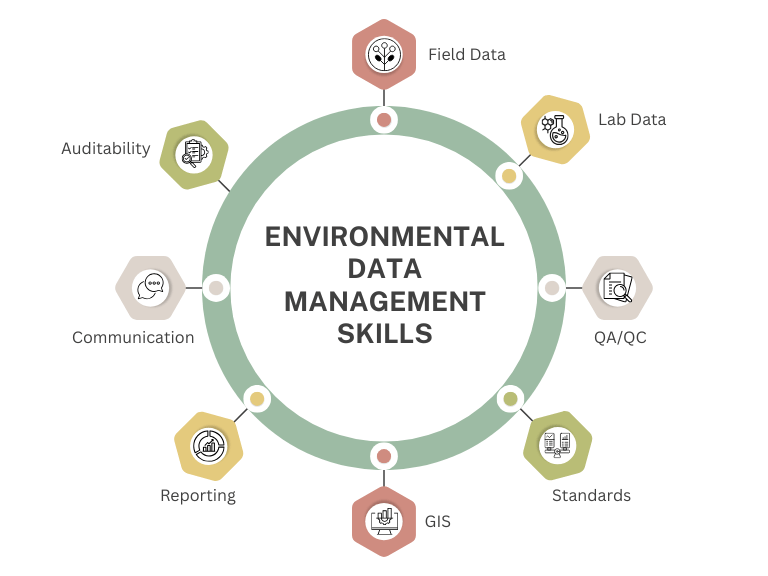
- The most important skills include field data planning, sample naming, QA/QC, laboratory data review, environmental standards comparison, GIS interpretation, data visualisation, reporting, audit trails, and understanding how data flows from field collection to final deliverable.
- Environmental professionals do not need to become database administrators, but they do need to understand data structure, data quality, regulatory context, and the consequences of poor data handling.
- Modern environmental data management software such as ESdat helps scientists manage field data, laboratory reports, standards comparisons, maps, graphs, tables, exceedance alerts, and reporting workflows in one system. ESdat describes itself as browser-based and designed for project managers and scientists rather than only specialist data teams.
- Students and early-career professionals who develop strong environmental data management skills can become more valuable because they can help projects move faster, reduce errors, improve compliance confidence, and communicate findings clearly.
1. What Is Environmental Data Management?
Environmental data management is the organised process of collecting, checking, storing, analysing, mapping, reporting, and sharing environmental data so it can be used with confidence.
It applies to many types of environmental information, including:
- soil sample results
- groundwater sample results
- surface water monitoring data
- sediment data
- air quality data
- vapour intrusion data
- landfill gas data
- field parameters
- borehole logs
- sample locations
- laboratory reports
- logger and sensor data
- regulatory guideline values
- maps and spatial layers
- remediation monitoring data
- long-term compliance records
In simple terms, environmental data management answers one question:
Can we trust the data enough to make decisions, submit reports, and demonstrate compliance?
A good environmental data workflow ensures that data is complete, traceable, accurate, comparable, and easy to interpret.
View our complete guide on What is Environmental Data Management Software?
2. Why Environmental Data Management Matters
Environmental projects generate large volumes of data. Without good systems, that data can become scattered across field sheets, spreadsheets, laboratory PDFs, email attachments, GIS files, SharePoint folders, consultant reports, and legacy databases.
That creates problems:
- results may be missed
- sample IDs may not match
- units may be inconsistent
- duplicate data may be created
- old results may be hard to find
- exceedances may be overlooked
- reports may take longer to prepare
- regulatory submissions may be harder to defend
- teams may rely on one “spreadsheet expert”
- historical trends may be hidden
ESdat identifies common problems with legacy environmental database systems, including siloed data, total cost of ownership, slow data loading, and reliance on specialist data or IT teams. See ESdat’s comparison article on environmental data management and compliance monitoring.
For environmental scientists, this means data management is not just an administrative task. It affects scientific interpretation, project risk, regulatory compliance, client confidence, and professional credibility.
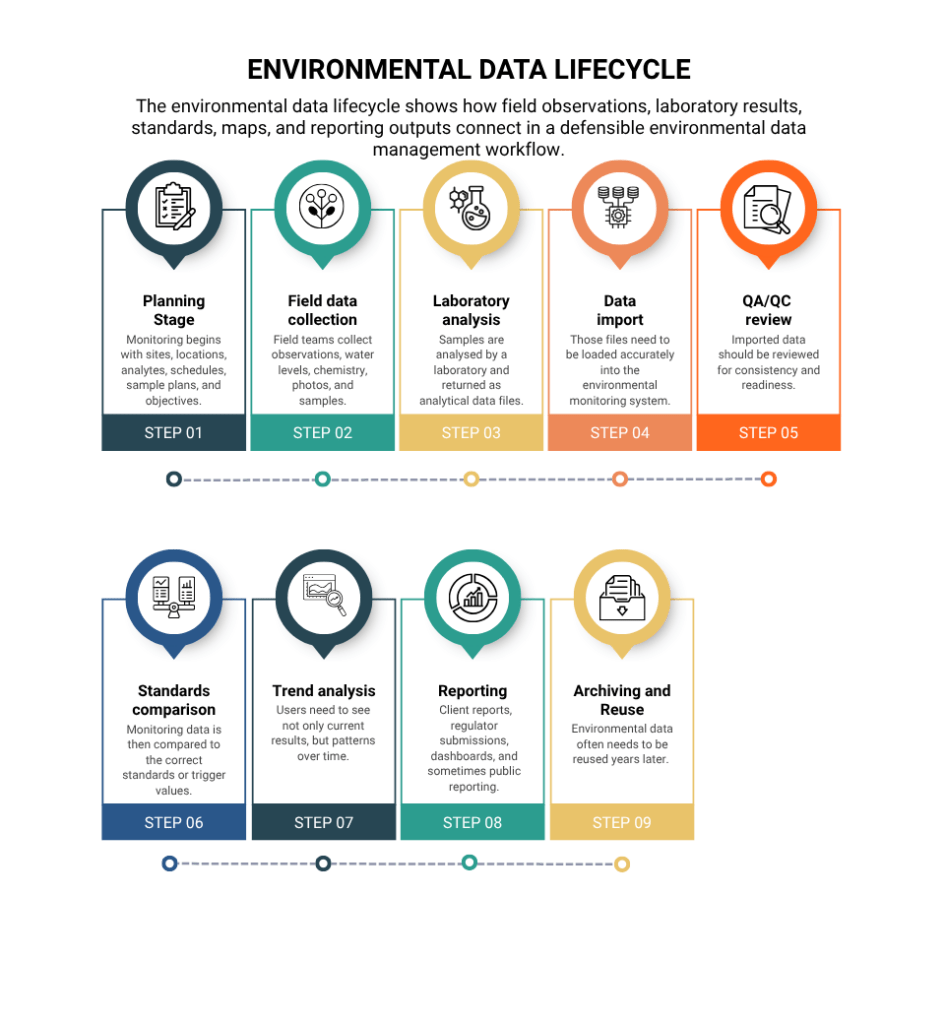
3. The Environmental Data Lifecycle
Environmental data usually moves through a lifecycle.
Stage 1: Planning
Before fieldwork starts, the team defines:
- project objectives
- sampling locations
- analytes
- field parameters
- laboratory methods
- regulatory standards
- data quality objectives
- reporting requirements
- naming conventions
- chains of custody
- QA/QC samples
- deliverable formats
Good data management starts before a sample is collected.
Stage 2: Field Collection
Field staff collect:
- sample IDs
- location information
- depths
- dates and times
- field readings
- observations
- photos
- equipment details
- weather notes
- groundwater levels
- purging information
- QA/QC samples
The goal is to capture field data consistently and reduce transcription errors.
Stage 3: Laboratory Submission
Samples are submitted to the laboratory with a chain of custody. The lab returns analytical results, often as PDF reports, spreadsheets, or electronic data deliverables.
Stage 4: Data Import and Validation
Data must be checked for:
- correct project
- correct sample IDs
- correct dates
- correct units
- correct analytes
- correct detection limits
- duplicate records
- missing results
- holding time issues
- lab qualifiers
- field/lab mismatches
ESdat’s Laboratory Integration page shows how accredited laboratories can automatically upload lab reports into ESdat, with LabSync validating data against quality checks and reporting errors back to users and laboratories.
Stage 5: Standards Comparison
Results are compared against relevant environmental standards, such as soil, groundwater, surface water, vapour, drinking water, ecological, landfill, or site-specific criteria.
Stage 6: Analysis and Interpretation
Scientists review:
- exceedances
- trends
- spatial patterns
- contaminant distribution
- source areas
- plume behaviour
- remediation progress
- compliance status
- data gaps
Stage 7: Reporting and Communication
Data is turned into:
- tables
- graphs
- maps
- exceedance summaries
- statistical summaries
- compliance reports
- regulator submissions
- dashboards
- client briefings
- public portals
Stage 8: Archiving and Reuse
Environmental data often needs to be reused years later. Long-running sites may require trend analysis, historical comparisons, audit trails, and defensible records.
4. Core Environmental Data Management Skills
Environmental scientists need a mix of technical, scientific, regulatory, and communication skills.
The most important skills are:
- Understanding environmental data types
- Planning data collection before fieldwork
- Using consistent sample naming conventions
- Recording accurate field data
- Understanding laboratory reports
- Checking units, methods, analytes, and detection limits
- Applying QA/QC principles
- Comparing data against environmental standards
- Understanding spatial data and maps
- Creating clear tables, graphs, and figures
- Managing data in structured systems
- Maintaining audit trails
- Explaining results to clients, regulators, and project teams
- Knowing when data is good enough to support a decision
- Recognising when data is incomplete or unreliable
These skills help scientists move from “collecting data” to “using data professionally.”
5. Field Data Management Skills
Field data is often the foundation of an environmental project. If field data is inconsistent, incomplete, or poorly labelled, the entire project can be affected.
Environmental scientists should know how to:
- prepare field forms before mobilisation
- use consistent sample IDs
- record accurate sample depths
- capture GPS or surveyed coordinates
- document field conditions
- record groundwater levels correctly
- use calibrated meters
- document calibration checks
- collect duplicate, blank, and rinsate samples where required
- link photos to locations and dates
- record deviations from the sampling plan
- complete chains of custody correctly
- check field data before leaving site
Example
A groundwater monitoring team collects samples from 30 wells. If one well is recorded as “MW-01” in the field sheet, “MW01” on the chain of custody, and “MW_1” in the lab report, the data may not load correctly into a database. It may also be harder to compare with historical results.
Good field data management prevents these problems before they reach the reporting stage.
6. Laboratory Data Management Skills
Laboratory data is central to contaminated land, water quality, mining, landfill, and compliance projects.
Environmental scientists should understand:
- laboratory reports
- electronic data deliverables
- analyte names
- detection limits
- reporting limits
- units
- qualifiers
- holding times
- sample receipt conditions
- method blanks
- duplicates
- matrix spikes
- surrogate recoveries
- chain of custody records
- lab accreditation requirements
They should also understand that analytical data is not “ready to use” just because it has been received.
It must be checked.
Practical example
A soil sample may report lead in mg/kg, while a water sample reports lead in µg/L. A scientist must understand that these are different matrices and units. Comparing them without context would be meaningless.
ESdat example
ESdat’s lab integration functionality is designed to reduce manual handling of laboratory reports. Its Laboratory Integration page shows results are automatically loaded into corresponding projects, sample information can be assigned using common industry sample IDs, and data can be viewed as tables, graphs, or maps.
7. QA/QC and Validation Skills
QA/QC means quality assurance and quality control. It is the process of checking whether data is suitable for its intended use.
Environmental scientists should be able to ask:
- Are all expected samples present?
- Are sample IDs correct?
- Are dates and times reasonable?
- Are units consistent?
- Are detection limits appropriate?
- Are duplicates within acceptable limits?
- Are blanks clean?
- Are holding times met?
- Are lab qualifiers understood?
- Are results consistent with field observations?
- Are exceedances real or caused by data errors?
- Is the dataset complete enough for the decision being made?
QA/QC is not only a laboratory responsibility. It is also a consultant, regulator, and project management responsibility.
Why this matters
A single incorrect unit, misplaced decimal, or mismatched sample ID can change the interpretation of a site. In compliance work, that can lead to incorrect reporting, delayed decisions, or avoidable risk.
ESdat’s website highlights automatic validation, exceedance notifications, audit trails, configurable data quality objectives, and review/approval of lab reports as part of its laboratory integration and quality assurance workflow. See ESdat Laboratory Integration.
8. Environmental Standards and Compliance Skills
Environmental scientists need to understand how data is compared against relevant standards, guidelines, trigger values, screening levels, and site-specific criteria.
This includes knowing:
- which standard applies
- which land use applies
- which matrix applies
- whether criteria are health-based or ecological
- whether pH, hardness, depth, salinity, or other factors affect criteria
- whether background concentrations matter
- whether a result is above or below detection limits
- whether an exceedance is meaningful
- how to communicate exceedances clearly
Practical example
A groundwater result may exceed a drinking water guideline but the aquifer may not be used for drinking water. That does not mean the result is irrelevant, but it does mean the scientist must interpret the exceedance in the correct regulatory and exposure context.
ESdat example
ESdat comes preconfigured with out-of-the-box regulatory Environmental Standards, laboratory data integration, and standard outputs and reports. See ESdat’s comparison article on environmental data management and compliance monitoring.
This is important because standards comparison is one of the most time-consuming and risk-sensitive parts of environmental reporting.
9. GIS, Mapping, and Spatial Data Skills
Environmental data is often spatial. Sample locations, boreholes, monitoring wells, contamination plumes, groundwater flow directions, site boundaries, land uses, receptors, and infrastructure all depend on location.
Environmental scientists should understand:
- coordinate systems
- sample location naming
- GPS limitations
- GIS layers
- site plans
- groundwater contours
- plume maps
- exceedance maps
- spatial trends
- WMS/WFS layers
- integration with GIS software
- map-based querying
A scientist does not always need to be a GIS specialist, but they should understand how spatial data affects interpretation.
Practical example
Two groundwater wells may have similar contaminant concentrations, but their significance depends on location. One may be upgradient of a source area and the other downgradient near a receptor. Without spatial context, the data has limited meaning.
10. Data Analysis and Reporting Skills
Environmental scientists must turn data into usable outputs.
They should be able to produce and interpret:
- chemistry tables
- exceedance tables
- time-series graphs
- concentration trend charts
- hydrographs
- maps
- statistical summaries
- QA/QC summaries
- compliance dashboards
- regulator-ready exports
- client summaries
The goal is not to make data look impressive. The goal is to make data understandable, traceable, and decision-ready.
What good reporting looks like
A good environmental data report should answer:
- What was sampled?
- Where was it sampled?
- When was it sampled?
- What was analysed?
- What standards were used?
- What exceeded those standards?
- Are there trends?
- Are there data gaps?
- What does the data mean?
- What action is recommended?
ESdat includes reporting outputs such as tables, graphs, maps, statistics, and standard reports according to its overview material.
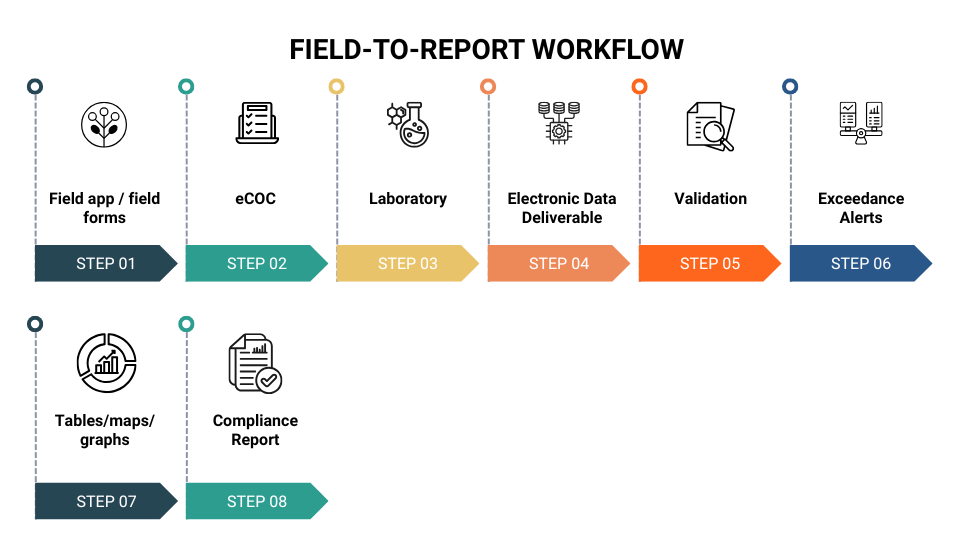
11. Workflow Example: From Fieldwork to Compliance Report
Here is a simplified workflow for a groundwater monitoring project.
Step 1: Plan the monitoring event
The project manager defines wells, analytes, standards, sampling methods, QA/QC requirements, and reporting outputs.
Step 2: Prepare field forms
The field team receives digital forms or field sheets with the correct well IDs, required parameters, and sample naming conventions.
Step 3: Collect field data
The team records groundwater levels, purging data, stabilisation readings, sample IDs, observations, and QA/QC samples.
Step 4: Submit samples to the laboratory
The chain of custody is completed and samples are sent to the laboratory.
Step 5: Receive laboratory results
The lab provides results as a report and/or electronic data file.
Step 6: Validate the data
The team checks sample IDs, units, dates, analytes, detection limits, qualifiers, and QA/QC results.
Step 7: Compare against standards
Results are compared with relevant groundwater criteria.
Step 8: Review exceedances
The scientist reviews exceedances by location, contaminant, depth, and historical trend.
Step 9: Prepare outputs
Tables, graphs, maps, and exceedance summaries are generated.
Step 10: Interpret and report
The scientist explains whether conditions are improving, stable, or worsening and whether further action is required.
12. Practical Examples by Industry
Contaminated land consulting
Environmental consultants need data management skills to support Phase II investigations, remediation validation, groundwater monitoring, vapour assessments, and regulatory reporting.
They must manage multiple matrices, including soil, groundwater, surface water, vapour, sediment, and waste.
Mining
Mining projects often involve long-term monitoring of groundwater, surface water, seepage, dust, tailings, rehabilitation, and compliance obligations.
Data management skills help teams identify trends, prepare reports, and maintain defensible records over many years.
Landfills
Landfill monitoring may involve groundwater, leachate, surface water, landfill gas, stormwater, and odour data.
Environmental scientists need to identify exceedances, track trends, and respond quickly when data indicates potential environmental risk.
Government and regulators
Government users need clean, structured, transparent data for assessment, auditing, community reporting, and long-term environmental protection.
The Shoalhaven Council Aquadata case study is an example of environmental monitoring data being made accessible through a public interface after field and laboratory data are uploaded and approved.
Schools and public health projects
The Terraphase case study shows how automated lab result validation, import, and exceedance notifications can support lead monitoring in schools.
13. How ESdat Supports Environmental Data Management Skills
Environmental professionals still need to understand data management principles. Software does not replace professional judgement. However, software can make good workflows easier to apply.
ESdat supports environmental data management by helping teams:
- import laboratory data
- capture field data
- compare results with environmental standards
- manage sample locations
- view data in tables, maps, and graphs
- receive lab report notifications
- receive exceedance notifications
- reduce manual transcription
- maintain audit trails
- support data review and approval
- prepare standard outputs and reports
- manage data across projects and sites
ESdat positions itself as a browser-based environmental data management system designed for project managers and scientists, with features such as laboratory integration, environmental standards, field programs, logger data, data analysis and reporting, and public portal functionality. See ESdat’s comparison article on environmental data management and compliance monitoring.
This matters for students and early-career professionals because it shows how modern environmental practice is changing. The best scientists are not only good at collecting samples. They are also good at managing the information those samples produce.
14. Common Environmental Data Management Mistakes
Mistake 1: Treating data management as an afterthought
Data management should begin at project planning, not after lab results arrive.
Mistake 2: Using inconsistent sample names
Small naming differences can create major import, matching, and reporting problems.
Mistake 3: Relying too heavily on spreadsheets
Spreadsheets are useful, but they are not ideal as the main system of record for complex, long-term, multi-user environmental datasets.
Mistake 4: Ignoring units
Unit errors can completely change interpretation.
Mistake 5: Not checking detection limits
A non-detect result is not always equivalent to “zero.” Detection limits matter.
Mistake 6: Comparing results to the wrong standards
The wrong matrix, land use, jurisdiction, or exposure pathway can lead to poor decisions.
Mistake 7: Losing historical context
Environmental monitoring is often about trends. If old data is hard to find, trend analysis becomes weaker.
Mistake 8: Separating maps from chemistry data
Environmental interpretation often depends on both concentration and location.
Mistake 9: Not maintaining audit trails
Regulatory and compliance work requires traceability.
Mistake 10: Creating reports that are hard to understand
Good environmental reporting should make complex data clear.
15. Skills Checklist for Students and Graduates
Students and early-career environmental scientists should aim to develop the following skills.
Field data skills
- Use field forms accurately
- Understand sample IDs
- Record dates, depths, and locations correctly
- Complete chains of custody
- Collect QA/QC samples
- Check data before leaving site
Laboratory data skills
- Read lab reports
- Understand detection limits
- Understand units
- Recognise qualifiers
- Check sample completeness
- Review QA/QC results
Data quality skills
- Identify missing data
- Identify inconsistent units
- Identify duplicate records
- Understand validation checks
- Know when to ask questions
Standards skills
- Choose relevant criteria
- Understand land use and matrix
- Interpret exceedances
- Avoid overclaiming
- Explain uncertainty
Digital skills
- Use environmental data management software
- Work with tables, maps, and graphs
- Understand structured data
- Export reports
- Maintain traceability
Communication skills
- Summarise key findings
- Explain data limitations
- Write clear report sections
- Prepare visuals
- Communicate exceedances responsibly
16. Glossary
Chain of custody
A record that tracks sample collection, handling, transfer, and receipt by the laboratory.
Data validation
The process of checking data for completeness, accuracy, consistency, and suitability for use.
Detection limit
The lowest concentration that can be reliably detected by an analytical method.
Electronic data deliverable
A structured electronic file provided by a laboratory or data source for import into a database or software system.
Environmental data management
The process of collecting, validating, storing, analysing, visualising, reporting, and sharing environmental data.
Environmental data management software
Software designed to manage environmental datasets, including field data, lab results, standards comparisons, maps, graphs, reports, and compliance workflows.
Environmental standards
Regulatory or guideline values used to assess environmental data against health, ecological, compliance, or site-specific criteria.
Exceedance
A result that is above a relevant standard, guideline, trigger value, or screening criterion.
Field data
Data collected during site activities, such as sample IDs, locations, depths, observations, groundwater levels, and field measurements.
QA/QC
Quality assurance and quality control processes used to check whether data is reliable and fit for purpose.
Spatial data
Data with a location component, such as coordinates, sample locations, wells, site boundaries, or GIS layers.
17. FAQs
What environmental data management skills do environmental scientists need?
Environmental scientists need skills in field data capture, sample naming, laboratory data review, QA/QC, standards comparison, GIS interpretation, data visualisation, reporting, and auditability. They should understand how data moves from field collection to laboratory analysis, validation, interpretation, and final reporting.
Why is environmental data management important?
Environmental data management is important because environmental decisions depend on reliable data. Poor data management can lead to missed exceedances, incorrect reporting, duplicated work, inconsistent results, and weak regulatory submissions.
Do environmental scientists need to know databases?
Environmental scientists do not usually need to become database administrators, but they should understand structured data, sample IDs, fields, units, validation, metadata, and how environmental data is stored and retrieved.
What is the difference between environmental data and environmental information?
Environmental data usually refers to raw or structured measurements, such as laboratory results or field readings. Environmental information is the meaning derived from that data, such as whether a contaminant exceeds a guideline or whether a plume is stable.
Why are spreadsheets risky for environmental data management?
Spreadsheets are flexible but can be risky for complex environmental datasets because they are prone to version control issues, manual transcription errors, broken formulas, inconsistent naming, and limited audit trails.
What is QA/QC in environmental data management?
QA/QC is the process of checking whether environmental data is complete, accurate, consistent, and suitable for its intended use. It includes checks on sample IDs, units, detection limits, blanks, duplicates, lab qualifiers, and completeness.
How does laboratory integration help environmental projects?
Laboratory integration reduces manual data entry, improves consistency, speeds up reporting, and helps detect errors earlier. ESdat says accredited laboratories can automatically upload lab reports, with validation checks and notifications for new reports or exceedances.
How does environmental data management support compliance?
It supports compliance by ensuring that data is traceable, checked, compared against relevant standards, reported clearly, and available for audits or regulatory review.
What should students learn first?
Students should first learn sample naming, field data recording, chain of custody, basic lab report review, units, detection limits, QA/QC principles, environmental standards, and clear data presentation.
How does ESdat fit into environmental data management?
ESdat is environmental data management software that helps environmental professionals manage field data, laboratory data, environmental standards, maps, graphs, reports, and compliance workflows. ESdat describes itself as browser-based and designed for project managers and scientists to directly access and interpret environmental data.
Suggested Links
- ESdat Environmental Data Management Software homepage
- Laboratory Integration
- Environmental Standards
- Field Programs
- Data Analysis and Reporting
- Logger Data
- Public Portal
- ESdat vs EQuIS alternative page
- Investing in the Next Generation of Environmental Site Leaders
- Terraphase LabSync case study
- Shoalhaven Council Aquadata case study
- Case studies hub