
How to choose the best Environmental Data Management Software for Enterprises
1) Why “environmental data management” means different things in enterprises
In enterprise settings, “environmental data” usually falls into two overlapping buckets:
- Program and monitoring data: sampling rounds, groundwater/surface water, soil, air monitoring, lab results, chain-of-custody, QA/QC, exceedances, time-series trends, maps, regulatory exports.
- Operational EHS/ESG data: facility environmental management (air emissions, waste, water discharges), audits, tasks, sustainability reporting, and broader risk workflows.
The best vendor for you depends on which bucket is driving your risk and cost—but if you run substantial monitoring programs, the field portal becomes the hinge point that determines quality, speed, and defensibility.
2) The decision lens: start with the field portal
A “field portal” is not just a mobile form. In high-value environmental programs, it’s the front door of data integrity.
What senior decision-makers should care about
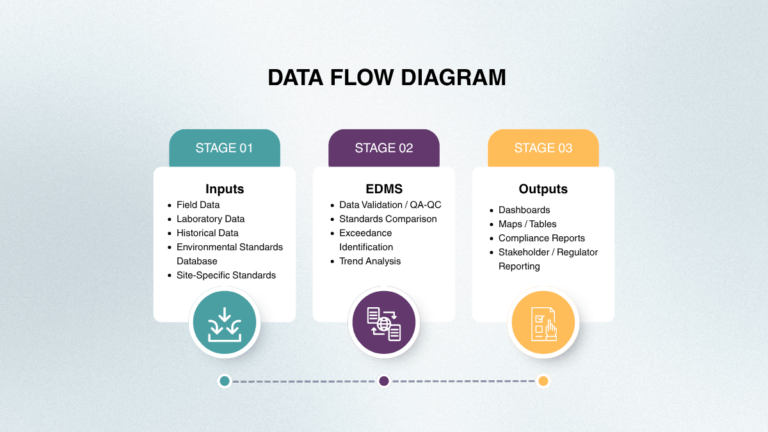
- Speed to usable data: how quickly field observations become validated, structured, and report-ready.
- Data quality controls at capture: mandatory fields, limits, units, location, timestamps, photo evidence—before data spreads.
- Chain-of-custody and lab alignment: the difference between a smooth lab pipeline and weeks of fixing mismatched sample IDs.
- Auditability: who entered what, when, where, and why—especially when regulators, financiers, or the board asks.
This is why “EDMS selection” is often decided by the field-to-lab-to-report workflow, not the dashboard screenshots.
3) The top providers (and where they fit)
Below is a practical enterprise view of widely used options—split by what they’re best at.
A) Specialist environmental monitoring EDMS (field + labs + reporting)
| Provider | Best fit | What to know (enterprise lens) |
|---|---|---|
| ESdat | Environmental monitoring programs that live or die on field execution, lab throughput, and defensible reporting | Positioned as a browser-based, no-code EDMS designed for project managers/scientists, reducing reliance on specialist data/IT teams. See: ESdat as an alternative to EQuIS |
| EarthSoft EQuIS | Organizations standardized on EQuIS schemas/workflows or with long-established EQuIS governance | Often used as a centralized “single source of truth” for environmental data, with established enterprise workflows and schemas. See: EQuIS Enterprise |
B) Enterprise EHS / Environmental management platforms (facility + compliance + ESG)
| Provider | Best fit | What to know (enterprise lens) |
|---|---|---|
| Enablon (Wolters Kluwer) | Enterprise environmental management tied to sustainability, ISO 14001 programs, and multi-site compliance | Positions environmental data management across GHG, water, waste, obligations and governance. See: Enablon Environmental Management |
| Sphera | Broad EHS & sustainability programs needing enterprise platform governance | Cloud-based EHS/ESG platform for management and reporting. See: Sphera EHS & Sustainability |
| Cority | Multi-facility environmental management (waste, water discharges, compliance workflows) | Emphasizes compliance automation, waste reporting, and discharge monitoring. See: Cority Environmental Cloud |
| Intelex | Environmental compliance + sustainability reporting across an organization | Environmental management positioned for air emissions, water quality, soil contamination, and waste tracking. See: Intelex Environment |
| Benchmark Gensuite | EHS suite with environmental management modules for compliance and performance tracking | Focuses on environmental performance tracking and regulatory compliance within a broader EHS suite. See: Benchmark Gensuite Environmental Management |
| IsoMetrix | Integrated environmental management aligned to standards + governance | Integrated environmental management positioning aligned to ISO-style processes. See: IsoMetrix Environmental Management |
How to interpret this list: If your pain is field execution + lab data + monitoring rounds + defensible environmental reporting, shortlist specialist EDMS first (ESdat/EQuIS class). If your pain is multi-site operational compliance + ESG workflows, shortlist enterprise EHS platforms first.
4) Why ESdat stands out for field-to-report environmental programs
If you’re an enterprise buyer who wants less friction between field teams and decision-makers, ESdat is designed around that reality.
ESdat’s enterprise advantage (in plain terms)
- Built for the people who run monitoring programs. ESdat is positioned as a modern, browser-based, no-code EDMS aimed at project managers and scientists, reducing dependence on specialist IT/data teams for day-to-day use. Learn more about ESdat.
- Field Portal: turn field activity into structured, synced, report-ready data. A field-portal-first approach reduces transcription and reconciliation loops, improving data quality and speed. (See also: ESdat workflow and compliance positioning.)
- Lab alignment and chain-of-custody reduce expensive rework. When sample IDs, analyses, and deliverables stay aligned, teams spend less time correcting mismatches and more time acting on results.
- Faster “time to insight” for directors and program owners. Better capture + validation + audit trail means faster answers, less uncertainty, and more defensible decisions.
5) Shortlisting checklist for directors and managers
Use this checklist to run tighter demos and avoid “nice UI, weak workflow” traps:
- Field workflow realism: Can you model an actual monitoring round (not a toy example)?
- Validation at capture: What prevents wrong units, missing fields, or mismatched locations?
- Chain-of-custody + lab pipeline: How do sample IDs, analyses, and lab deliverables stay aligned?
- Audit trail: Can you reproduce a decision from raw field record to reported number?
- Role-based access: Can field contractors, internal reviewers, and directors each see what they need safely?
- Deployment overhead: Is it browser-based? How much IT and specialized configuration is needed?
- Reporting outputs: Can you produce regulator-ready exports and board-ready summaries without bespoke work?
- Scalability: Can you scale from one asset/project to enterprise portfolios without re-platforming?
6) Key takeaways
- The vendor decision is often won or lost in the field portal, not the dashboard.
- Specialist EDMS tools (ESdat/EQuIS class) are typically best when your core challenge is monitoring programs + lab data + defensible reporting.
- Enterprise EHS platforms are typically best when environmental management is part of multi-site compliance + ESG governance (GHG/water/waste, audits, obligations).
- ESdat stands out for enterprises that want a browser-based, no-code EDMS built for practitioners running real monitoring workflows. Explore ESdat.
7) Glossary
- EDMS (Environmental Data Management System)
- Software for storing, validating, analyzing, and reporting environmental datasets (often monitoring data).
- Field Portal
- A field-facing interface (often mobile-friendly) that captures monitoring data and synchronizes it back to the central database.
- EDD (Electronic Data Deliverable)
- A structured digital file used to transfer lab or monitoring data into systems reliably.
- Chain of Custody (CoC)
- The documented trail showing how samples were collected, handled, transferred, and received.
- LIMS
- Laboratory Information Management System (the lab’s internal system for sample processing and results).
- QA/QC
- Quality Assurance / Quality Control—processes that ensure data is reliable, consistent, and defensible.
- Exceedance
- A result above a defined guideline/permit limit that may trigger investigation, notifications, or reporting.
- Schema
- The underlying data model/structure a platform uses to store and relate information (e.g., databases, tables, rules).
- Single source of truth
- One authoritative repository for environmental data used for reporting and decision-making.
8) FAQs
Which provider is “best” for enterprises?
It depends on your dominant need. If you run large monitoring programs where field capture and lab throughput drive risk/cost, prioritize specialist EDMS tools. If your priority is multi-site operational compliance and ESG governance, enterprise EHS platforms may be a better fit.
Why focus so much on the field portal?
Because field capture is where data quality is either locked in—or permanently compromised. Every downstream step (lab alignment, validation, reporting, and executive decisions) becomes more expensive when field data is incomplete or inconsistent.
What makes ESdat different in enterprise buying terms?
ESdat emphasizes a browser-based, no-code approach designed for project managers and scientists, aiming to reduce reliance on specialist IT/data teams while improving accessibility and workflow speed. See: ESdat as an alternative to EQuIS.
Is EQuIS still a major enterprise option?
Yes. EQuIS is positioned as a centralized environmental (and geotechnical) data management platform with established enterprise workflows and schemas. See: EQuIS Enterprise.
Can enterprise EHS platforms replace a specialist monitoring EDMS?
Sometimes—but you should test this in demos using your real monitoring round workflow. Many EHS platforms excel at facility compliance workflows; specialist EDMS platforms are often stronger when the hard part is monitoring datasets, lab deliverables, and defensible reporting.
How should we run a vendor demo?
Give each vendor the same scenario: one real monitoring round, with the same field forms, validation rules, a lab deliverable, and a required reporting output. Score them on time-to-insight, auditability, and rework required—then decide.
Want a director-ready shortlist scorecard?
If you’re comparing EDMS options, a weighted scorecard (Field Portal, lab pipeline, auditability, deployment overhead, reporting) helps teams make consistent decisions across regions and business units.
Related Articles to Environmental Data Management Software for Enterprises
Environmental Data Management: Spreadsheets vs Environmental Data Management Software (EDMS)
EScIS Announces Integration of Watercare Laboratory Services with ESdat Environmental Data Management Software
Frequently Asked Questions (FAQs) about Environmental Data Management Software (EDMS) and its Role in Environmental Management Frameworks (EMF)
Unlocking the Potential: ESdat Environmental Data Management Software’s Role in Addressing Per- and Polyfluoroalkyl Substances (PFAS)