

TL;DR: A monitoring round is a discrete sampling campaign—one window in time when you collect field and lab data from a defined set of locations. It’s the backbone that lets environmental teams organise results, compare periods, prove compliance, and tell clear trend stories.
What exactly is a “monitoring round”?
In plain terms, a monitoring round is a named period (e.g., “Q2 2025 Groundwater”) during which you sample your network—wells, surface water sites, bores, air samplers, noise points, etc.—and send those samples to the lab. The round label becomes the anchor that ties together field measurements, chain-of-custody, laboratory results, QA/QC, and ultimately your reporting for that period.
Different regions and software use cousins of the term—sampling event, field event, campaign, round ID—but they all serve the same purpose: grouping samples taken at (roughly) the same time so you can compare like-with-like.
Why monitoring rounds matter
Clarity & comparability. By grouping data into rounds, you can compare the June campaign to the September campaign without confusing seasonal effects or one-off anomalies. Plotting “by round” makes trends legible for clients, regulators, and internal reviewers.
Compliance confidence. Licences and permits are written in time: monthly dust, quarterly groundwater, wet/dry season surface water, annual mass loading, etc. Rounds give you a clean record that the right sampling happened at the right time and at the right places—with the right QA/QC.
Workflow control. Rounds create a natural checklist. Before you head to site, you know which locations and parameters are in scope. After the lab reports, you can confirm completeness and chase missing results before reports go out.
How rounds fit in your data model
Think of a round as a container with consistent metadata:
- Round metadata: name/ID, start–end dates, project/site, purpose (routine, validation, incident response), people responsible, and any special instructions (e.g., PFAS precautions).
- Sampling plan: the set of locations and parameters scheduled for that round.
- QA/QC plan: duplicates, blanks, trip spikes, calibration logs mapped to that round.
- Results: field readings and lab results that reference the round ID.
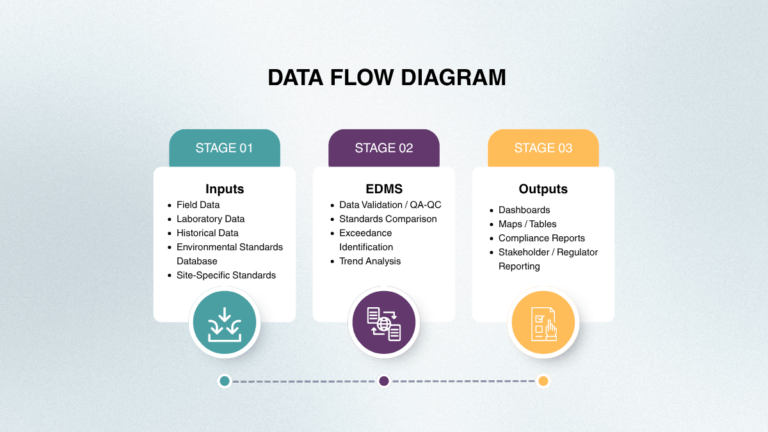
In environmental data management systems, this is explicit. You’ll often see a Monitoring Round or Sampling Event field set at import; all child records (samples, results, attachments) inherit that context. When you run “Results by Monitoring Round,” the system knows exactly what to group.
Field and lab realities that shape a round
Rounds aren’t always a single day. For groundwater networks spread over a region, a round might span several days or weeks due to access, safety, or purging logistics. That’s okay—what matters is a clearly defined window and consistent methods.
If you miss a location (locked gate, dry bore), record it explicitly in round-level completeness notes. If severe weather forces a split, document why and whether any methods changed. The round label is still valid; the audit trail explains the exception.
On the lab side, include the Round ID on your chain-of-custody and in your EDD/CSV so results land in the right bucket. This small habit prevents painful re-keying and reporting errors later.
Naming conventions that save you hours
Pick a naming pattern and stick to it:
- Quarterly: GW-Q1-2025, GW-Q2-2025
- Monthly: SW-2025-08
- Seasonal: Dry-2025, Wet-2025
- Special: Incident-2025-10-19, Validation-Stage1-2025
Keep them short, sortable, and unambiguous (use ISO-like YYYY-MM and avoid spaces). Document the convention in your sampling plan so contractors and labs use exactly the same IDs.
Scheduling and frequency (and why “round” helps reporting)
Rounds map directly to licence conditions and internal KPIs—quarterly landfill leachate, seasonal eco-tox, monthly stormwater grab samples, 24-hr TSP runs on a 1-in-6-day schedule, etc. Because each data point carries the round label, you can produce “Round-to-Round Change” tables, rolling medians, and trend charts that actually mean something. When you need more rigour, the same grouping enables non-parametric tests (e.g., Mann–Kendall) without messy filtering.
QA/QC that belongs at the round level
Good programs attach QA/QC to the round, not just the sample:
- Planned vs achieved: list scheduled locations and what was actually sampled.
- QA/QC coverage: confirm duplicates/blanks meet method and frequency.
- Instrument checks: calibration records tied to the round window.
- Holding times & custody: validate timing and preservation against round dates.
- Data validation outcome: qualifiers and reasons, aggregated by round.
This lets you state, with evidence, “The Q3 2025 round achieved 96% completeness; one location was inaccessible; all PFAS trip blanks were non-detect.”
Common pitfalls (and quick fixes)
- Inconsistent round names. If the lab uses “Aug-25” and the field team writes “2025-08,” your import will splinter. Fix: publish and enforce a single naming rule in sampling plans, labels, and purchase orders.
- Overlapping round windows. Results get mis-grouped, trends wobble. Fix: close one round before opening the next; document overruns.
- QA/QC detached from rounds. Duplicates with no context are hard to defend. Fix: assign QA/QC in the plan and verify coverage in a round-level checklist before reporting.
- Missing EDD fields. Roundless CSVs create manual work and errors. Fix: require round fields in all lab EDDs and field uploads.
A mini-scenario
A consulting team manages 45 groundwater wells at a manufacturing site, with quarterly compliance. They define GW-Q3-2025 (1–21 September) and pre-load the plan into their EDMS. During the round, two wells are dry; they record this and collect a field duplicate at MW-12. The lab EDD includes MONITORING_ROUND = GW-Q3-2025 on all results and blanks. In reporting, they show round-to-round change for each well and a trend chart across the last eight rounds. The regulator’s key question—“Are PFAS concentrations decreasing after the source control?”—is answered clearly, because all evidence hangs off consistent rounds.
Learn how Monitoring Rounds in ESdat Environmental Data Management Software help consultants organise sampling events, link field and lab data, and produce faster, more accurate environmental reports.
Equivalent terms you’ll see
- Monitoring Round (widely used in AUS/NZ/UK practice; common in EDMS UIs)
- Sampling Event / Field Event (frequent in North American documents and some software)
- Campaign (often used in air/noise programs)
Treat them as synonyms, but pick one in your documents for consistency.
Quick start (six moves to get it right)
- Choose a naming convention and add it to your sampling plan and lab POs.
- Define the window (start–end dates) and locations before mobilising.
- Pre-load the round in your EDMS so field and lab data can reference it.
- Tag everything (field sheets, CoC, EDDs) with the round ID.
- Check completeness and QA/QC coverage before you draft results.
- Report by round with concise change summaries and trend visuals.
Related Articles to Monitoring Rounds
Why Use an EDMS for Environmental & Landfill Compliance Monitoring (and Why Many Teams Choose ESdat)
ESdat: A Comprehensive Solution for Environmental Data Management
99% of Environmental Lab Reports Loaded Without Error Using ESdat