

The Massachusetts Department of Environmental Protection (MassDEP) has finalized significant amendments to the Massachusetts Contingency Plan (MCP), 310 CMR 40.0000, which governs the notification, assessment, and remediation of oil and hazardous material releases. These updates, effective March 1, 2024, modernize the MCP to reflect new science, address stakeholder feedback, and improve implementation clarity.
Key Takeaways
- PFAS Standards Finalized: Six PFAS compounds now have Method 1 cleanup standards and Reportable Concentrations.
- Soil EPC Clarifications: New guidance for calculating Exposure Point Concentrations (EPCs)—especially in soil—emphasizes professional judgment and sampling strategy updates.
- Coal Tar Focused Provisions: Only visible coal tar waste deposits are now assessed, avoiding broader waste classifications and applying distinct risk thresholds.
- Climate Change Consideration: Cleanups must now assess foreseeable climate impacts using official EOEEA projections.
- AEPMMs Monitoring: Vapor intrusion systems (e.g., subslab depressurization) must now monitor both pressure and shutdowns, though retroactive changes are not required.
Tier Class & Status Reports: Clarified rules for Temporary Solutions and when Tier Classification extensions are required, with reduced reporting burdens for low-risk sites.
Summary of Key Amendments
1. PFAS Standards Integrated
MassDEP finalized cleanup standards and Reportable Concentrations for six PFAS in coordination with drinking water regulations. These were completed in 2019 to align with 310 CMR 22.00.
2. Exposure Point Concentrations (EPCs)
The new rules offer refined EPC methodologies, including:
- Allowing judgmental vs. systematic sampling approaches
- Clarifying when to apply the upper confidence limit (UCL) on the mean
- Improving consistency across environmental media (soil, groundwater, indoor air, sediment, hot spots)
3. Coal Tar Waste Characterization
Rather than broadly classifying waste deposits as “Hot Spots,” the MCP now:
- Targets visible coal tar waste (common at former gas plants)
- Requires qualitative EPCs for these distinct deposits
- Replaces the confusing term “Upper Concentration Limit” with “Method 3 Ceiling Limit”
4. Active Exposure Pathway Mitigation Measures (AEPMMs)
Clarifications include:
- AEPMMs now include both positive pressure and subslab depressurization systems
- New requirements to monitor pressure ranges, not just shutdowns
- Remote telemetry for vapor mitigation systems must be registered
- New documentation rules for private well treatment systems
5. Climate Change Resilience
Sites must now evaluate the potential for climate change to undermine cleanup permanence. Assessments must be based on data from the Executive Office of Energy and Environmental Affairs (EOEEA). Applies to Permanent Solutions only.
6. Tier Classification & Temporary Solutions
- Sites with Temporary Solutions must maintain Tier Classification, but with more flexibility:
- Extensions can now be submitted post-expiration.
- Annual Status Reports are not needed unless MassDEP specifically requires them.
- Transition provisions clarify how to manage expired Tier Classifications.
Implementation Timeline
- Available: September 1, 2023 (MassDEP website)
- Effective: March 1, 2024
- MassDEP will conduct training and outreach for environmental professionals and Licensed Site Professionals (LSPs).
Glossary
| Term | Definition |
| MCP (Massachusetts Contingency Plan) | The regulatory framework for cleaning up oil/hazardous material releases in Massachusetts. |
| EPC (Exposure Point Concentration) | The estimated concentration of a contaminant at a location where human or environmental exposure is likely. |
| PFAS (Per- and Polyfluoroalkyl Substances) | A group of man-made chemicals known for persistence in the environment and potential health risks. |
| AEPMM (Active Exposure Pathway Mitigation Measure) | Systems that actively prevent exposure to contaminants, such as vapor intrusion systems. |
| Tier Classification | The regulatory status of a site, based on its complexity and risk, which determines the level of oversight. |
| Temporary Solution | A site status where risk is controlled but not permanently eliminated. |
| EOEEA | Massachusetts Executive Office of Energy and Environmental Affairs; provides climate projection data. |
More Info
Accessing Standards in ESdat
The updated Massachusetts MCP standards—along with many others—are available via the ESdat Environmental Standards Reference Library.
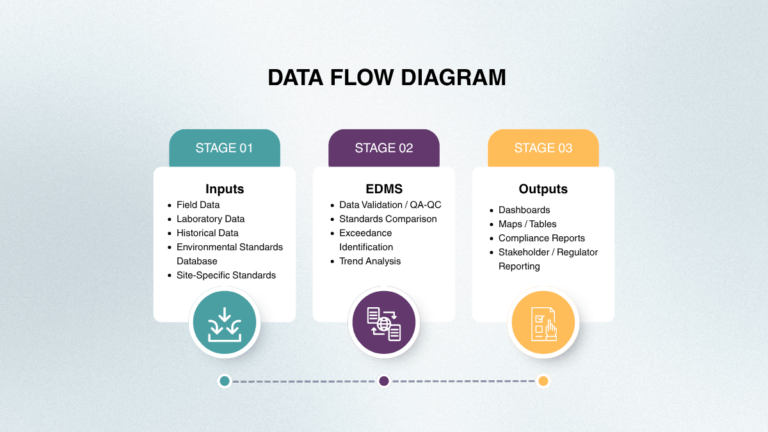
ESdat (Environmental Data Management Software) provides a pre-compiled library of environmental guidelines, making it easy for environmental professionals to stay compliant and monitor exceedances efficiently.
Features:
- Pre-loaded with regulatory guidelines from the US, Canada, Australia, New Zealand, the UK, and more
- Add custom environmental standards or site-specific limits
- Receive real-time alerts for guideline exceedances
- Supports conditional dependencies (e.g. pH, hardness, depth, matrix)
- Compare against lab and field data in Chemistry Tables, Maps, Graphs, and other visual outputs
For environmental professionals managing complex sites or multiple regulatory frameworks, ESdat offers a robust, efficient, and transparent solution to streamline compliance and data analysis.
Related Articles to Massachusetts Contingency Plan
What are the Massachusetts Contingency Plan (MCP) Numerical Standards?
What are Massachusetts MCP Standards for?
Massachusetts MCP Standards
What are US environmental standards?