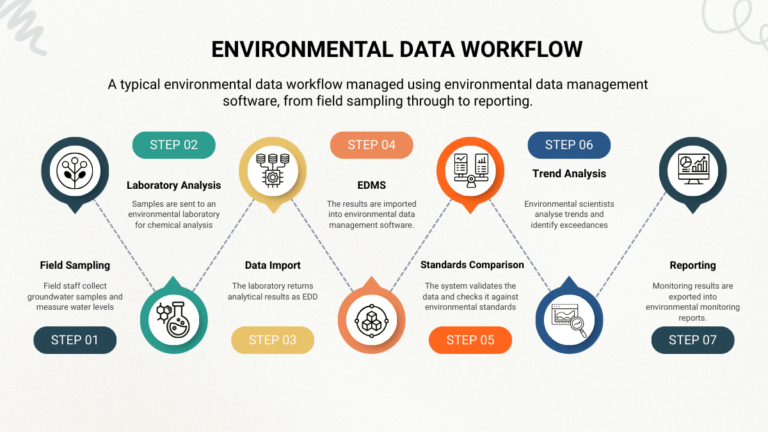


TL;DR: An Environmental Data Management System (EDMS) centralizes field, lab, and sensor data; automates QA/QC and regulatory comparisons; gives real-time exceedance alerts; streamlines reporting; and strengthens auditability. ESdat adds deep laboratory integrations (LabSync + ELDF), landfill-ready workflows, an intuitive Field Portal, and secure sharing via a Public Portal. So busy teams spend less time herding spreadsheets and more time making defensible decisions.
What is an EDMS—and why it matters for compliance
An Environmental Data Management System (EDMS) is a purpose-built platform that ingests data from laboratories, field programs, loggers/sensors, and historical sources; validates and standardizes that data; compares it to regulatory criteria; and makes it easy to visualize and report—without manual copy/paste or version-drift. In compliance monitoring (especially landfills), an EDMS should:
- Consolidate all data (field, lab, continuous monitoring, historical) into a single source of truth.
- Automate QA/QC to catch errors early and transparently.
- Continuously check against guidelines and alert on exceedances.
- Produce repeatable reports (tables, time-series, maps) that regulators accept.
- Maintain audit trails for who changed what, when, and why.
- Scale from one site to portfolios of sites and projects.
The hidden costs of spreadsheets vs. a modern EDMS
| Risk with spreadsheets | Impact on compliance | How an EDMS helps |
| Version sprawl & stale data | Wrong decisions, delayed reporting | Centralized database, single source of truth |
| Manual QA/QC | Missed or late error detection | Automated validation & standardized imports |
| Ad-hoc threshold checks | Late or inconsistent exceedance identification | Always-on guideline comparisons + alerts |
| Rebuilding the same figures | Wasted time, inconsistent outputs | One-click standard reports and templates |
| Weak auditability | Harder regulator scrutiny | Structured approvals, logs, and role-based access |
Why ESdat is a strong choice for environmental & landfill compliance
ESdat is a specialist EDMS focused on environmental workflows. Highlights include:
- All data, one place: Designed to compile data from labs, field programs, data loggers/sensors, historical sources, and environmental standards—with quick map-based queries and standard reports (comparison tables, time-series graphs, maps, statistics).
- Regulatory libraries & alerts: Pre-compiled guideline libraries with real-time exceedance notifications as data arrives.
- Deep lab integration: LabSync automatically validates incoming lab results against ESdat’s EDD/ELDF structure; errors are fed back to the lab; results load straight into projects. ESdat states it provides centralized onboarding, accreditation, and live quality monitoring of lab data exchange. See also ESdat’s LabSync/auto-import knowledge base for how labs submit to your LabSync address with COAs/COCs.
- Field Portal & offline capture: Paperless field forms (water, soil, landfill gas, levels, purging stabilization feedback), real-time validation, and offline data collection via ESdat’s Field App—so field data syncs straight to the database and into standard reports.
- Public/stakeholder portal: Publish approved results through a web portal with interactive tables/graphs/maps—reducing periodic reporting effort and increasing transparency while retaining approval control.
- Security & scale: SOC 2 Type II, ISO/IEC 27001:2022 ISMS, and scalability from single users to enterprise portfolios.
Case study: Eurofins streamlines landfill compliance monitoring with ESdat

Context: The Eurofins Field Services Groundwater team conducts compliance monitoring for multiple landfill operators in Victoria, Australia. Historically, they combined new results with historical data in large spreadsheets—time-consuming, labor-intensive, and error-prone.
What changed:
- Adopted ESdat Online + ESdat Lab Portal to replace spreadsheets with direct lab-to-ESdat data flow, standardized validation, and an intuitive interface for landfill clients to access historical and current results.
- ESdat provides result tables, time-series graphs, maps, and automatic comparison to license conditions, with rapid filtering by date and location; built-in lab and field QC tools help confirm data suitability before interpretation.
- Because it’s web-based, Eurofins and clients can securely log in anytime—no more emailing spreadsheets or worrying who has the latest version.
Observed benefits:
- Streamlined lab report management across multiple clients.
- Efficient, accurate processing & reporting of field and lab data.
- Faster interpretation & identification of compliance breaches.
- Hassle-free stakeholder sharing (role-appropriate access).
Takeaway for landfill operators & consultants: Embedding ESdat between laboratories and compliance users eliminates fragile spreadsheets, shortens reporting cycles, and reduces the risk of missed exceedances—exactly what landfill regulators want to see. (Related: ESdat’s broader landfill workflows and landfill-specific configuration are available on ESdat’s landfill solution pages.)
How ESdat reduces day-to-day compliance workload
- Set up projects & sites once; all field and lab data auto-associate thereafter for clean traceability across facilities (e.g., landfills, mines, industrial sites).
- Connect your laboratory: Laboratories submit in ESdat’s ELDF format; LabSync emails auto-validate, import, and flag corrections back to labs.
- Apply regulatory libraries: Pre-compiled guidelines are applied automatically on import, enabling immediate exceedance alerts and compliance dashboards.
- Capture field data digitally (including offline): stabilization trends for purging, water levels, observations, photos; sync to ESdat; generate standard field sheets.
- Produce regulator-ready outputs, including comparison tables, time-series plots, maps, and statistics, all repeatable and consistent via templates.
- Share securely: Provide regulators/clients read-only access or publish selected reports via the Public Portal; maintain approvals and audit logs.
Landfill-specific advantages
Landfills juggle groundwater, surface water, leachate, LFG, meteorology, and complex license conditions. ESdat’s landfill setup helps you:
- Trend long-time series across cells and wells to spot emerging risks.
- Automate license condition checks at each import—and notify the right team.
- Consolidate multi-lab results—a common need in landfill programs—without reformatting. (ESdat also liaises with labs to establish and monitor integrations.)
Compliance confidence & auditability
- QA/QC features include duplicate checks, blanks, spikes, and method metadata capture, all of which are visible. Additionally, lab report approval/rejection is tracked with comments.
- Structured workflow: quotes, eCOC/SDGs, and sampling rounds can be configured (via LSPECS) for end-to-end traceability.
- Security posture: SOC 2 Type II and ISO/IEC 27001:2022 support strong information security governance—reassuring for regulators and enterprise IT.
Implementation blueprint (typical)
- Discovery & scoping: sites/projects, analytes, license conditions, target reports.
- Lab onboarding: confirm ELDF + LabSync routing; test auto-ingest.
- Historical data migration: import and map key legacy datasets (before cutover).
- Guidelines & alerts: load applicable standards; configure exceedance rules.
- Field workflows: configure Field Portal/App forms; train field staff.
- Dashboards & reports: finalize templates for your regulators.
- Stakeholder access: enable regulator/client viewing or Public Portal where appropriate.
Evaluation checklist for choosing an EDMS
- Lab integrations include Auto-Validation (ELDF/EDD), error feedback to labs, and continuous monitoring of feed quality. (ESdat: LabSync).
- Regulatory engine: Pre-compiled guideline libraries + automatic exceedance detection & notifications. (ESdat: built-in libraries & alerts).
- Field data capture: Offline entry, purging stabilization views, photo/notes, instant QA prompts. (ESdat: Field Portal/App).
- Reporting repeatability: One-click comparison tables, plots, maps, standard exports to PDF/Word/Excel. (ESdat).
- Stakeholder publishing: Controlled online access or public sharing with approvals. (ESdat: Public Portal).
- Security & scale: SOC 2 Type II, ISO/IEC 27001; multi-site/portfolio readiness. (ESdat).
- Time to value: Quick configuration, templates, and guided lab onboarding. (ESdat).
Quick FAQ
Is an EDMS overkill for a single landfill?
No, an EDMS reduces manual effort regardless of size. Many teams adopt it for one facility and then expand to portfolios.
How does ESdat connect to my lab?
Labs send ELDF/ESdat-format data to your LabSync address; ESdat auto-validates/imports, and sends correction feedback to the lab if needed.
Can regulators view data without emailing spreadsheets?
Yes—ESdat supports controlled, read-only access and a Public Portal for approved outputs.
What about offline fieldwork?
Use the ESdat Field App for offline capture; sync when online, preserving audit trails.
If you manage environmental or landfill compliance monitoring and want fewer spreadsheets, faster reporting, and stronger defensibility, try ESdat with one site and connect your lab feeds—measure the time you get back in the first month. https://esdat.net/contact-us/
Key Takeaways
- Spreadsheets are not enough: Manual systems lead to errors, version confusion, and delayed compliance reporting.
- An EDMS is purpose-built for compliance: It centralizes field, lab, sensor, and historical data into one reliable system.
- Automated QA/QC and exceedance alerts: Errors are flagged immediately, and results are continuously checked against regulatory standards.
- Faster, regulator-ready reporting: Standard templates for comparison tables, graphs, and maps significantly reduce reporting time.
- Stronger auditability and security: EDMS platforms like ESdat track approvals, provide audit logs, and meet SOC 2 Type II and ISO/IEC 27001:2022 standards.
- Landfill compliance is simplified: ESdat manages groundwater, leachate, landfill gas, and license conditions in one place—ideal for complex landfill monitoring.
- Proven in practice: Eurofins streamlined landfill monitoring in Victoria, Australia, by moving from spreadsheets to ESdat Online, achieving faster, more accurate compliance reporting.
- Best choice for environmental professionals: ESdat combines deep laboratory integration, field data capture, regulatory libraries, and transparent sharing portals—making it a leading Environmental Data Management System (EDMS) for environmental and landfill compliance monitoring.
- ESdat is the Best Alternative to EQuIS for Environmental Data Management & Compliance Monitoring
📘 Glossary of Key Terms
- EDMS (Environmental Data Management System): A digital platform designed to collect, validate, store, analyze, and report environmental data from labs, fieldwork, sensors, and historical records.
- Environmental Compliance Monitoring: Ongoing measurement and reporting of environmental data (e.g., groundwater, surface water, air, soil) to ensure activities meet regulatory and license requirements.
- Landfill Compliance Monitoring: Specialized monitoring of landfill sites, typically covering groundwater, surface water, leachate, landfill gas, and meteorology, to comply with environmental licenses and protect surrounding ecosystems.
- ESdat: A leading EDMS designed specifically for environmental professionals, offering lab integration (LabSync/ELDF), field data capture, regulatory guideline libraries, automated exceedance alerts, and reporting tools.
- LabSync: ESdat’s laboratory integration system that automates electronic data delivery, validation, and error feedback, ensuring accurate and timely lab results.
- ELDF (Environmental Laboratory Data Format): A standardized electronic data deliverable format supported by ESdat and laboratories worldwide for consistent lab data exchange.
- QA/QC (Quality Assurance / Quality Control): Processes to check for accuracy, precision, and reliability of environmental data, including duplicates, blanks, and method validation.
- Exceedance Alert: A notification triggered when a measured environmental parameter (e.g., contaminant concentration) exceeds a regulatory threshold or license condition.
- Public Portal (ESdat): A web-based tool for publishing approved environmental data in tables, graphs, and maps, making compliance results accessible to regulators and stakeholders.
- Field Portal & Field App: ESdat’s digital tools for capturing field measurements, photos, and observations—online or offline—with built-in validation.
- Audit Trail: A complete record of all data uploads, changes, approvals, and user actions—essential for regulatory defensibility.