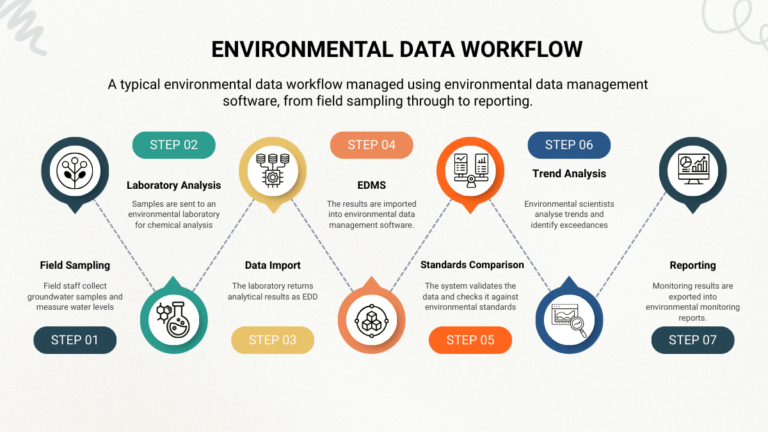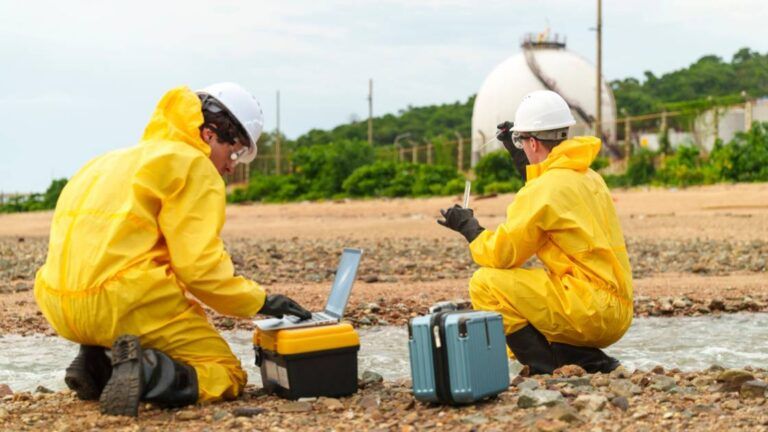


Geotechnical and environmental data describe the same piece of ground from two very different perspectives: one asks, “Can we build safely here?” while the other asks, “Is this place healthy for people and ecosystems?” For modern projects, both are needed to make structurally sound, environmentally responsible decisions.
What geotechnical data is
Geotechnical data captures how soil and rock behave as engineering materials under load. It is used to design foundations, earthworks, slopes, tunnels, roads, and other infrastructure that must remain stable over time.
Common elements include:
- Soil and rock classification (e.g., clay, sand, gravel, rock type) and grain size distributions are used to infer strength and compressibility.
- In situ and laboratory test results, such as strength, stiffness, hydraulic conductivity, and rock mass quality, are often summarised in borehole logs and geotechnical data reports.
What environmental data is
Environmental data describes the condition of the natural world and the impacts of human activities on air, water, soil, biodiversity, and climate. It functions as a set of “vital signs” for ecosystems, human health, and resource sustainability.
Typical categories include:
- Pollution indicators such as air pollutants (NOx, SO2, particulate matter), water quality parameters (pH, nutrients, metals), and soil contaminants (hydrocarbons, pesticides, heavy metals).
- Ecological, climate, and resource metrics, including rainfall, temperature, species counts, vegetation cover, and groundwater or surface water levels.
Key differences in focus and use
Although both data types may be collected from the same site, they answer different primary questions and follow different regulatory and design pathways.
| Aspect | Geotechnical data | Environmental data |
|---|---|---|
| Core question | How will the ground support loads and remain stable? | What is the state of the environment and contamination risk? |
| Typical drivers | Structural safety, serviceability, construction feasibility. | Human health, ecosystems, legal compliance, and remediation. |
| Main parameters | Strength, stiffness, density, permeability, stratigraphy. | Pollutant concentrations, water/air/soil quality, biodiversity, climate variables. |
| Investigation style | Drilling, in situ tests, lab strength and classification tests. | Sampling and monitoring of air, water, soil, biota, and emission sources. |
| Primary users | Environmental scientists, regulators, public health officials, and planning agencies. | Environmental scientists, regulators, public health, and planning agencies. |
Site investigations: where the rigs go
In practice, the distinction becomes clear in where and why each dataset is collected within a project.
- Geotechnical investigations target locations where infrastructure will be built, such as building footprints, road alignments, bridge abutments, and retaining walls, to test load‑bearing capacity and ground behaviour.
- Environmental investigations target “suspect” zones such as former fuel tanks, industrial areas, or site boundaries, to delineate contamination plumes and assess liabilities under environmental regulations.
Why both datasets now matter together
For contemporary planners, engineers, and regulators, geotechnical and environmental data are increasingly interdependent rather than separate silos. Geotechnical drilling can double as a sampling opportunity for groundwater and soil contamination, while environmental constraints can change foundation options, excavation method,s and spoil management strategies.
Key takeaways
- Geotechnical data is collected to understand ground conditions for design and construction (e.g., soil/rock strength, compressibility, groundwater conditions that affect stability).
- Environmental data is collected to understand contamination, risk, and compliance (e.g., chemicals in soil/groundwater, vapours, surface water), and to support decisions such as remediation and reporting.
- The two overlap at the same site because both use subsurface sampling and groundwater information, but their purposes, analytes/tests, and reporting outputs differ.
- A common failure point is fragmented data (field notes, labs, bore logs, spreadsheets). Centralising, validating, and standardising data reduces errors and rework.
- “Geotechnical data management software” is generally described as a system for storing, organising, checking, and reporting geotechnical data from investigations.
Glossary (plain-English, site-focused)
AGS (Association of Geotechnical & Geoenvironmental Specialists) format
A common UK data exchange format used to standardise the transfer of ground investigation data between organisations/tools.
Analyte
A specific chemical being tested for (e.g., benzene, PFAS, lead).
Borehole
A drilled hole used to log soil/rock layers and/or collect samples and install instruments.
Borehole log/bore log
A record of what was encountered in the borehole (layers, depths, materials, groundwater observations).
Chain of custody (CoC)
Documentation that tracks samples from collection through transport to the lab—used to protect defensibility.
Conceptual Site Model (CSM)
A structured picture of sources–pathways–receptors used in environmental risk assessment.
CPT (Cone Penetration Test)
An in-situ test where an instrumented cone is pushed into the ground to infer soil properties and stratigraphy.
Environmental data
Site data used to assess contamination, exposure risk, and regulatory compliance (commonly chemical concentrations + supporting field measurements).
Exceedance
A result above a guideline/trigger/standard (often requiring assessment, resampling, or action).
Geotechnical data
Site data used to assess engineering behaviour of soil/rock and groundwater for safe, buildable design (foundations, slopes, retaining structures, pavements, etc.).
Groundwater monitoring well (bore/well)
A constructed well is used to measure groundwater level and/or take groundwater samples over time.
In-situ test
A test performed in the ground (e.g., CPT, SPT) rather than in a laboratory.
QA/QC (Quality Assurance / Quality Control)
Checks that ensure data is reliable (e.g., duplicates, blanks, lab qualifiers, validation rules).
SPT (Standard Penetration Test)
A common in-situ test producing an “N-value” (blow count) is used to infer soil properties.
Trigger level/guideline
A benchmark used to flag potential concern (e.g., investigation levels for contaminants, project design criteria, or spec limits).
FAQs
What’s the simplest difference between geotechnical and environmental data?
Geotechnical data tells you how the ground will behave for engineering design.
Environmental data tells you whether the ground (soil, water, vapour) is contaminated and what the risk/compliance implications are.
Do geotechnical and environmental teams collect data in the same places?
Often not. A typical pattern is:
- Geotechnical drilling focuses on where structures will be built (footings, pads, alignments).
- Environmental drilling focuses on where contamination is suspected (historic activities, boundaries, hotspots).
What are common examples of geotechnical data collected on a site?
- Soil/rock descriptions and stratigraphy (layers, depth to bedrock)
- In-situ tests like SPT and CPT
- Groundwater level observations
- Laboratory geotech tests (e.g., moisture, Atterberg limits, shear strength, consolidation)
What are common examples of environmental data collected on a site?
- Soil and groundwater chemistry (contaminant concentrations)
- Vapour/soil gas data (where relevant)
- Field measurements (pH, EC, DO, turbidity) supporting sampling
- QA/QC results and lab qualifiers to judge reliability
Where does groundwater fit: geotechnical or environmental?
Both.
- Geotech uses groundwater levels/pressures for stability and design (e.g., excavation, slope stability).
- Environmental uses groundwater sampling to understand contaminant presence, migration, and compliance over time.
Why do these datasets get mixed up on real projects?
Because they can share:
- boreholes and locations,
- “bore” / “well” language,
- field logs and depth-based records,
- time-series measurements (water levels, monitoring rounds).
The difference is mainly the decisions the data is meant to support (design vs. risk/compliance).
What are the biggest data-management risks when both disciplines work on the same site?
- Duplicate or inconsistent location IDs (BH-01 vs B-1 vs MW-01)
- Units and methods not standardised
- Results stored in separate spreadsheets with no audit trail
- QA/QC not carried through into charts/tables
- Updates made without traceability
Digital tools often emphasise centralisation, validation, and tracking of changes to reduce these risks.
What should a “good” combined site dataset look like?
A good combined dataset is:
- standardised (consistent IDs, coordinates, units),
- validated (rules, QA flags, review status),
- queryable (filter by location, depth, date, analyte/test),
- reportable (repeatable outputs without manual copy/paste).
When would you intentionally keep geotechnical and environmental datasets separate?
When you have:
- different legal defensibility requirements and reporting pathways,
- different confidentiality constraints,
- different coordinate systems/data standards,
- different project phases with separate scope/ownership.
Even then, you usually still want a shared index (site locations + naming conventions) to avoid confusion.
What’s a practical “rule of thumb” for deciding what you’re looking at?
Ask: “Is this being used to design the structure, or to assess contamination risk/compliance?”
That one question quickly sorts most ambiguous datasets.
How ESdat can be used for geotechnical data management
Even though ESdat is best known as an environmental data management system, it supports a wide range of related datasets, including borehole/well construction and lithological/geotechnical/stratigraphic information, as well as groundwater and other time-series data.
Here are practical ways ESdat can support geotechnical data management workflows (especially on projects that also have environmental monitoring):
- Centralise geotech + groundwater datasets in one place. Keep borehole/well details, lithology/stratigraphy, groundwater levels, and related field observations together so engineering decisions aren’t based on scattered spreadsheets.
- Improve consistency and reduce manual handling. Using a structured system helps standardise location IDs, units, and data tables, reducing transcription errors and “version confusion” across teams.
- Make reporting repeatable. ESdat supports outputs like graphs, maps, statistics, and other reporting artefacts from managed datasets—useful when you need consistent deliverables across investigation stages.
- Connect geotechnical context to environmental outcomes (geo-environmental projects). On many sites, the geotech story (layers, permeability contrasts, groundwater gradients) is directly relevant to environmental interpretation. Managing them in one system can make cross-disciplinary interpretation faster and less error-prone.
- Integrate with downstream analytics and spatial tools. ESdat integrates with tools like Power BI and ArcGIS, which helps when you need dashboards, map views, or project-wide summaries built off the same validated dataset.
Related Articles on the Difference Between Geotechnical and Environmental Data
What Is Geotechnical Data Management Software?
Environmental Data Management Maturity Infographic
The Limits of Excel for Environmental Data Management — and the Case for an EDMS
Environmental Data Is Complex — Your System Shouldn’t Make It More So