
Westminster, Colorado — October 14–16, 2025. The RemTEC & Emerging Contaminants Summit returns this week to The Westin Westminster, bringing together regulators, researchers, consultants, and solution providers to tackle the toughest questions in contaminated site assessment and remediation. Think PFAS treatment that actually scales, regulatory perspectives you can act on, and pragmatic case studies that deliver lessons you’ll use on your next project.
Why this summit matters
RemTEC’s niche is depth plus practicality: sessions are designed around what’s moving the needle in field implementation and policy—not just lab curiosity. For practitioners wrestling with data defensibility, lab/field integration, and treatment trade-offs, RemTEC offers a curated, multi-track program and a high-signal exhibit hall to pressure-test solutions with peers and vendors.
Dates, venue and format at a glance
- Dates: October 14–16, 2025
- Venue: The Westin Westminster, 10600 Westminster Blvd, Westminster, CO 80020
- Format: Keynotes + tracked technical sessions + exhibits + posters + student program/networking These details come directly from RemTEC’s event pages and exhibitor resources.
Program highlights you can plan around
Bookend keynotes with immediate applicability
- Opening Keynote Panel — PFAS Legal Landscape: strategies to understand liability exposure and align remediation programs with evolving litigation and compliance risk.
- Closing Keynote — PFAS State & Federal Regulatory Perspectives: an inside look at state–federal alignment and what’s next for monitoring, treatment trains, and disposal/destruction compliance.
Why it matters: Counsel-informed program optics and regulator panels help you benchmark your site decisions (e.g., technology selection, residuals management) against where enforcement and policy are actually heading.
21 tracks mapped to real project challenges
The agenda spans 21 themed tracks. A few standouts:
- PFAS destructive technologies (from SCWO to mechanochemical approaches)
- Analytical frontiers (EPA 1633 vs HRMS, “dark PFAS,” and ultrashort chains)
- Treatment trains & demonstrations (side-by-side field trials; sediment washing, thermal desorption + oxidation)
- Microplastics (occurrence, monitoring, and source reduction)
- 6-PPD & transformation products (transport, analysis, and management)
- Wildfire impacts (post-fire water quality, DBP formation)
- Chlorinated solvents, 1,4-dioxane, and metals (bio/abiotic pathways and optimization)
What to look for:
- Field-scale results and GHG/externality accounting for PFAS destruction options (thermal/incineration/mechanochemical).
- Forensic/source apportionment to differentiate background vs site-derived PFAS—vital for liability and remedy scoping.
- Passive samplers & portable sensors that can tighten CSMs and reduce sampling uncertainty between rounds.
Student program & posters
Expect rapid-fire posters and a judged student competition—often a good preview of where methods and materials are headed (e.g., foam fractionation refinements, low-cost screening devices, biotransformation insights).
Exhibit hall intel: who’s there and how to navigate
From analytical labs and sampler innovators to in-situ amendments and destructive tech providers, the floor is engineered for hands-on Q&A and side-by-side comparisons. Use the published floor plan to plan targeted booth walks and reduce aisle wandering between sessions.
What’s new or notable in 2025 (quick read)
- Pre-conference PFAS visualization & modeling workshop to align site characterization, forensics, and remedy selection. If you build or review CSMs, this is worth the time.
- Demonstration-heavy PFAS sessions (e.g., thermal desorption plus oxidation, foam fractionation + SCWO) with real performance/scale data.
- Analytics catch-up on ultrashort chains and non-target screening—closing gaps that have complicated monitoring plans and closure strategies.
How to extract maximum value (for consultants, owners, and regulators)
- Pick one “change your practice” session per day. Use it to draft a mini-implementation plan (method, SOP tweak, or procurement criteria) before you leave the room.
- Trace a full PFAS lifecycle across tracks: source identification → interim controls (sorption/separation) → destructive options → residuals/disposal implications → GHG/externalities. This helps de-risk “solution hopping.”
- Validate your analytics. Compare your lab’s workflow against the latest on 1633 vs HRMS, ultrashorts, and portable field units; revise DQOs accordingly.
- Network with intent. Target track chairs and panelists whose work directly intersects your portfolio; schedule 15-minute coffee chats between sessions (they’re usually by the exhibit hall).
- Bring your data questions. Many exhibitors can walk through real datasets (anonymized) and show where their tools would change a decision (e.g., breakthrough curves, mass balances, QA flags).
Logistics & housekeeping
- On-site rhythm: Breakfast in the exhibit hall, morning/afternoon breaks timed with booth traffic, evening receptions for longer conversations.
- Tracks run concurrently: Skim the online agenda and star your must-attends in advance; PFAS tracks are spread across multiple rooms.
ESdat at RemTEC 2025 (Booth 226)
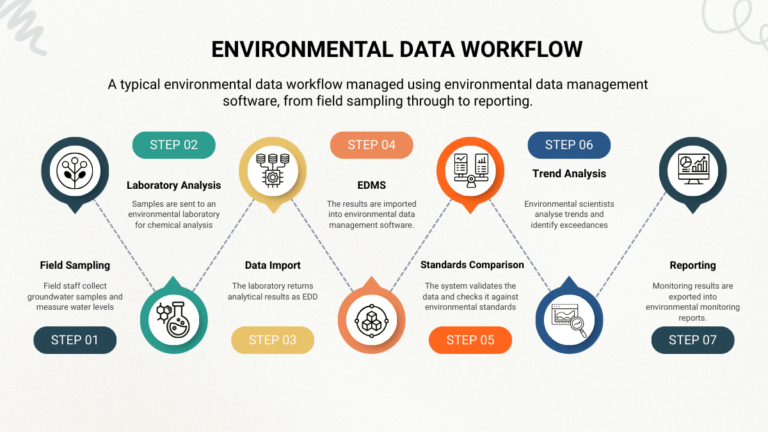
ESdat is an environmental data management system used by consultants, owners, and agencies to consolidate field, lab, logger, and historical datasets; apply QA/QC; and automate exceedance checks against pre-loaded regulatory standards (US, Canada, Australia/NZ, UK, and more). If you’re modernizing away from spreadsheets or stitching together lab EDDs, dashboards, and compliance tables, put ESdat on your shortlist.
What to ask at the booth:
- How LabSync validates and auto-loads lab results (and flags format errors before data lands in your system).
- How built-in standards libraries and exceedance alerts map to your jurisdictions and site-specific limits.
- Options for field program planning, COC, and mobile data capture—plus integrating legacy data and logger feeds.
Meet the team: ESdat is excited to be part of the RemTEC & Emerging Contaminants Summit 2025, taking place October 14–16 in Westminster, CO. Connect with Nick Tumney and Jane Mathisen at Booth 226 to explore how ESdat helps environmental professionals simplify data management, streamline reporting, and make confident, data-driven decisions for remediation and contaminated site projects.
Sources
- Official agenda & tracks: Remediation-Technology event site. https://www.remediation-technology.com/
- Event details & venue: Exhibitor resources and third-party event listings.
- Floor plan & sponsors: Event floor-plan page.
- Session specifics, keynotes, and schedules (handbook).
- About ESdat / features / standards: ESdat official pages. https://esdat.net/
Related RemTEC articles
US EPA Regional Screening Levels (RSLs) Updates
Health Canada: Objective for Canadian Drinking Water Quality Standards Per- and Polyfluoroalkyl Substances.
What are some common methods used in environmental remediation?