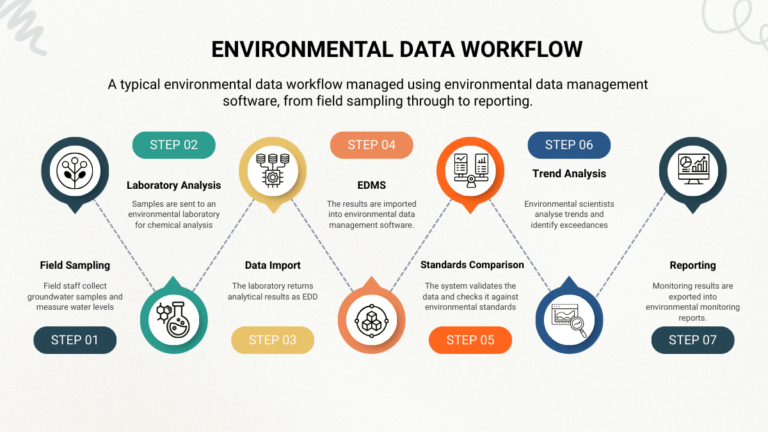

The ESdat Public Portal is a web-based feature designed to seamlessly share approved environmental monitoring data—such as groundwater, surface water, air quality, emissions, and borehole logs—with stakeholders, regulators, and the public.

How It Works
- Once an environmental report or dataset is approved within ESdat, it can be automatically published to a branded, customizable web portal .
- The portal features:
- Interactive maps with clickable monitoring points
- Tables and time-series graphs for data exploration
- Custom styling options: brand logo, colors, welcome message
- Access controls — publicly available or password-protected
Why Use the Public Portal?
1. Simplify Data Sharing
Manually compiling reports is time-consuming. The Public Portal automatically publishes approved datasets, freeing your team to focus on analysis.
2. Boost Transparency & Compliance
Provide regulators, clients, and the public with direct access to verified data, enhancing transparency and trust.
3. Build Stakeholder Confidence
Users can independently explore monitoring data—such as water quality or emissions—within maps and tables, improving data interpretation and confidence.
4. Customize & Control
Maintain control with a built-in approval system and the ability to restrict access to sensitive data. Plus, design a portal that reflects your corporate identity.
Advantages at a Glance
- Automated publication: Approved data flows directly to your portal—no manual intervention
- Interactive visuals: Maps, graphs, and tables support data exploration for non-technical users
- Access management: Public or restricted modes, based on your stakeholders’ needs
- Branded appearance: Custom styling reinforces your organisation’s identity
- Resource-efficient: Reduces workload and improves efficiency in stakeholder reporting
Who Uses It & How
- Mining companies (e.g., Tronox) use it to publish monitoring data like dust, water, and emissions.
- Local governments (e.g., Shoalhaven City Council) publish water quality data via GIS-enabled portals for community access.
For example see:
Bingo Industries https://bingoindustries-public.esdat.net/locations
NSW Environment Protection Authority (EPA) https://webreports.esdat.net/LakeMacquarie/locations
Tronox https://tronox-public.esdat.net/CristalMining#/results-map
Aquadata https://webreports.esdat.net/SCC/locations/376/Chemgraph
Nationwide Reach in Environmental Data Management
The Public Portal builds on the full ESdat environmental data management system, which includes modules for:
- Field programs and app-based data collection
- Laboratory integration with automatic result validation
- Real-time logger data feeds
- Chemical exceedance detection, QA/QC workflows, and reporting
- Mapping, graphing, and visualization tools
How the Public Portal Completes the ESdat Workflow
| ESdat Module | Purpose | Public Portal’s Role |
|---|---|---|
| Field App & LabSync | Data collection and laboratory uploads | Hosts approved results in user-friendly portal |
| QA/QC & Exceedance | Validates and flags data | Presents verified data to stakeholders |
| Maps & Charts | Internal analysis tools | Enhances external visibility and transparency |
Why It’s a Game-Changer
Environmental data management requires not just collection and analysis, but also trusted communication. The ESdat Public Portal completes this loop by enabling secure, automated, and visually engaging sharing of environmental monitoring results.
In summary, the ESdat Public Portal offers:
- Automated publication of verified environmental data
- Customizable presentation with maps, charts, and tables
- Access control to suit regulatory or public sharing needs
- A reduction in manual reporting workload
- Enhanced transparency and stakeholder engagement in environmental management