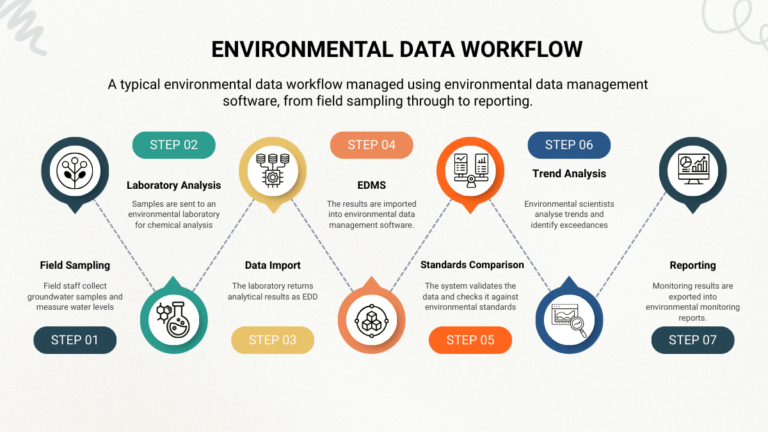


For many organisations today, environmental data is growing in volume and complexity. Groundwater monitoring, chemical sampling, lab reports, emissions, field data logging — the kinds and amounts of data multiply quickly. Without a capable EDMS, several painful realities emerge:
- Data becomes disconnected across silos (spreadsheets, lab PDFs, internal databases), making it harder to get a unified view.
- Compliance becomes a headache: with evolving regulations, site-specific standards, and multiple data types, manually compiling reports is time-consuming, error-prone, and inefficient.
- Maintenance burden grows: legacy or on-premise systems can demand a dedicated IT/data team just to keep them running. For smaller or mid-size projects, that overhead often outweighs the benefit.
- Slow workflows: lab data loading, validation, error-checking, data consolidation — these steps create delays, slow decision-making, and reduce agility (especially when multiple sites/projects are involved).
For senior leaders accountable for compliance, operational efficiency, and ESG reporting, these problems carry real risks — from regulatory noncompliance to project delays to unnecessary cost and resource drain.
The Hidden Cost & Risks of Sticking With Legacy or Inadequate EDMS
Imagine continuing with an EDMS that wasn’t built for today’s environmental demands—or, worse, relying on spreadsheets and ad hoc patchwork systems. The cost isn’t just wasted hours — it’s strategic exposure:
- Regulatory risk & liability: Manual data consolidation and validation increase the chance of errors or missed exceedances. That’s a compliance risk.
- Hidden overheads and inefficiencies: Maintaining legacy systems — including installations, updates, IT support, and server downtime — can become a drain. Smaller projects get penalised by the same overheads as large ones.
- Delayed decisions and lost agility: Waiting for lab data to be entered, validated, consolidated, and reporting results in slow responses to environmental hazards or compliance triggers — potentially causing harm, delays, or reputational damage.
- Under-utilised expert time: Scientists, project managers, and environmental specialists waste time on data wrangling instead of analysis and decision-making. That reduces value added.
- Scaling pain: As your organisation grows — more sites, more data, more stakeholders — a weak EDMS becomes a bottleneck. Data inconsistencies, version-control issues, and manual handoffs can multiply.
For leadership, these aren’t just “annoyances.” They’re operational and strategic liabilities — especially as regulatory scrutiny, ESG expectations, and volume of environmental data increase.
ESdat — A Modern, No-Code, Browser-Based EDMS Built for Real-World Environmental Work

Here’s why ESdat solves these problems in a way that aligns with how senior teams need to operate: reliably, efficiently, transparently, and at scale.
✅ Browser-Based & No-Code — Minimal IT Overhead, Maximum Accessibility
- ESdat is fully browser-based with no software installs required. That means no complex IT setup and instant accessibility via desktop, tablet, or mobile.
- Because it’s no-code, your environmental professionals — not just data specialists — can run it. There’s no reliance on a dedicated database or IT team.
- For busy organisations, this reduces overhead and risk, and makes deployment far faster and smoother than with legacy systems.
✅ Built for Environmental Compliance & Reporting
- ESdat comes pre-loaded with state and federal environmental guidelines, and supports built-in EPA compliance tools, including validation, submissions, and exports.
- It supports a wide range of data types: groundwater, soil, air, boreholes, logger data, lab analytical results, and field data — all in one system.
- That breadth is critical for organisations operating across multiple environmental domains (mining, consulting, government, waste, infrastructure).
✅ Reliable, High-Performance Data Handling — Even at Scale
- ESdat delivers a success rate of over 99% for lab data imports. That means minimal manual intervention, fewer transcription errors, and far more dependable data flow.
- Its user interface is designed to be fast and responsive, even with large datasets — reducing delays and downtime.
- Whether you handle a small site or a portfolio of hundreds, ESdat scales efficiently — no performance degradation, no inflated resource demands.
✅ Transparent Pricing and Predictable Budgeting
- Unlike many legacy EDMS with complex licensing, hidden fees, or variable costs, ESdat offers clear, up-front pricing and no surprises.
- For organisations evaluating total cost of ownership (TCO), that predictability is particularly valuable — especially when comparing an enterprise EDMS vs spreadsheets + manual workflows.
✅ Empowerment of Staff & Faster Decision-Making
- With ESdat, project managers and scientists can directly access, interpret, and report data — no more waiting on IT/Data teams or complex handoffs.
- That reduces bottlenecks and speeds up environmental compliance reporting, decision-making, risk detection, and remediation action.
- It flips the paradigm: instead of data management dictating how teams work, it’s a tool that supports and accelerates their work.
ESdat vs EQuIS — Why ESdat Often Makes More Sense (Especially for Mid- to Large-Scale Enterprises Who Value Efficiency)
While EQuIS remains a robust, widely used EDMS — particularly for very large portfolios and deeply specialized workflows — there are compelling reasons why ESdat may be a better fit for many modern organisations:
| Ease of use & user autonomy | ✅ Designed for project managers & scientists to use directly | ✖ Often requires specialist data/IT teams to manage | Reduces reliance on IT; speeds up workflows |
| Deployment & access | ✅ Fully browser-based, accessible anywhere with internet | ✖ Requires software install, more IT overhead | Lower friction for distributed teams, field + office access |
| Lab data integration & reliability | ✅ >99% import success, automatic validation & exceedance detection | ✖ More manual intervention, higher error risk | More reliable, less error-prone data ingestion |
| Scalability from small to large projects | ✅ Efficient across small and large projects | ✖ Resource-heavy; may be inefficient for smaller projects | More flexible and cost-effective for organisations of varying size |
| Compliance readiness & regulatory updates | ✅ Pre-loaded regulatory guidelines, regularly updated | ✖ Often requires manual setup and updates | Less risk of outdated standards or compliance oversight |
| Cost transparency & budgeting | ✅ Clear upfront pricing, no hidden costs | ✖ Complex, variable pricing models | Easier to budget, predictable TCO |
For many senior decision-makers, that translates into: better efficiency, lower risk, predictable cost, and faster time to value — without sacrificing the depth and robustness you need for compliance and environmental oversight.
Why ESdat Is Particularly Well-Suited to High-Value Companies / Organisations — Not Just Niche Firms
If your organisation:
- Operates across multiple sites, complex environmental programs, or long-term monitoring portfolios (e.g., mining, infrastructure, government, waste/landfill, consulting),
- Needs to comply with multiple jurisdictions or regulatory regimes (state, federal, and different countries),
- Values agility, scalability, and data-driven decision-making,
- Wants to reduce reliance on heavy IT/data teams and increase the autonomy of environmental staff,
Then ESdat makes a lot of sense.
Because it supports field data, lab data, logger data, geology/groundwater data, compliance thresholds, reporting, dashboards, and public-portal sharing — all in one unified system — it can serve as a “single source of truth.”
That reduces organisational complexity, lowers risk, streamlines compliance, and empowers your environmental teams.
Conclusion — A Strategic Choice That Reduces Risk, Overhead, and Accelerates Environmental Delivery
For senior directors and managers evaluating your EDMS options — whether you currently use EQuIS, spreadsheets, or a legacy system — the question isn’t just “what can you manage,” but “how efficiently, reliably, and scalably can you manage it?”
ESdat offers a modern approach: minimal IT overhead, intuitive use, broad data type coverage, reliable lab integration, built-in compliance workflows, transparent pricing — and, crucially, the ability for your scientists and project managers to take ownership.
For organisations that care about compliance, operational efficiency, scalability, and reducing hidden costs, ESdat is often not just a viable alternative to EQuIS but a strategic upgrade.
Key Takeaways
- Environmental data volume and complexity are rapidly increasing, making spreadsheets and legacy systems unsustainable for modern compliance requirements.
- Disconnected data sources create real operational risk, from missed exceedances to delayed action on environmental hazards.
- Legacy EDMS platforms require heavy IT involvement, slowing workflows and increasing project costs.
- ESdat is a modern, browser-based EDMS designed for environmental professionals, not IT teams — no installs, no coding, minimal configuration.
- It supports all major environmental data types (lab, field, groundwater, soil, air, logger, boreholes) in one platform.
- Compliance is built-in, with regularly updated environmental guidelines and automated validation/exceedance screening.
- ESdat’s >99% lab data import success rate delivers a far more reliable and consistent data pipeline.
- Transparent pricing gives organisations predictable budgeting and a lower total cost of ownership.
- Compared to EQuIS and other EDMS, ESdat offers faster deployment, easier adoption, lower overhead, and greater user autonomy.
- Ideal for multi-site, regulated organisations, ESdat enables faster decisions, reduces risk, and provides a single source of truth for environmental data.
Frequently Asked Questions (FAQs)
1. Why is environmental data becoming harder to manage?
Environmental programs now involve more sampling points, more contaminants, more types of data, and stricter reporting requirements. Spreadsheets and legacy tools can’t keep up with the volume, validation needs, or compliance expectations.
2. What are the risks of using outdated or inadequate EDMS systems?
Older systems introduce regulatory risk, data inconsistencies, manual errors, delays in decision-making, and unnecessary overhead due to high IT maintenance. As organisations scale, these issues grow exponentially.
3. How does ESdat help with environmental compliance?
ESdat includes built-in regulatory guidelines, automated validation, exceedance checks, and reporting tools aligned with environmental authorities. It reduces the chance of human error and ensures compliance reporting is accurate and consistent.
4. Is ESdat suitable for organisations with multiple sites or complex monitoring programs?
Yes. ESdat handles large datasets, multiple projects, and multi-site portfolios with ease. Its cloud-based, no-code design allows teams to access and work with data from anywhere.
5. How is ESdat different from EQuIS and other EDMS platforms?
ESdat is browser-based, no-code, easy to deploy, and purpose-built for environmental professionals rather than IT specialists. It offers faster setup, simpler workflows, higher data-import reliability, and transparent pricing — making it ideal for most environmental organisations.
6. What data types does ESdat support?
ESdat unifies groundwater, soil, surface water, lab results, field readings, air monitoring, logger data, borehole/geology, and site-specific compliance thresholds — all in one platform.
7. How long does it take to deploy ESdat?
Most organisations can be up and running within days. No software installation is required, and users can access the system immediately through their web browser.