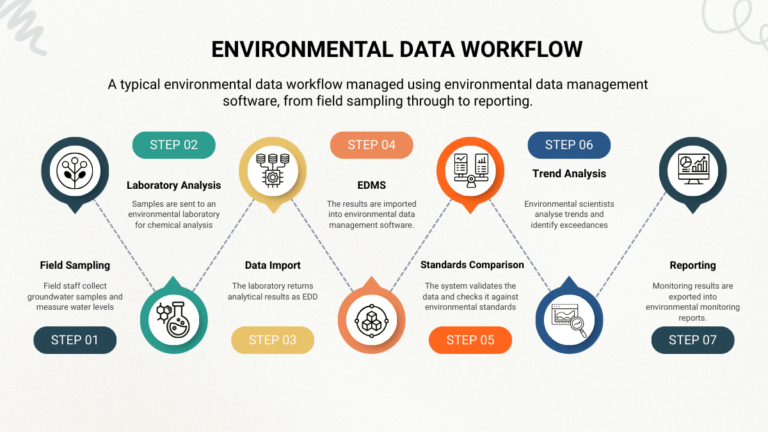


How do you choose the best environmental data management software for compliance reporting? Environmental compliance reporting is no longer just an operational task — it is a board-level risk function. Regulators expect defensible data, executives expect early visibility of risk, and communities expect transparency.
The right Environmental Data Management System (EDMS) reduces compliance exposure, accelerates reporting cycles, and gives leadership confidence that environmental obligations are being met.
Compliance reporting isn’t optional—it’s a non-negotiable line item on the balance sheet, with fines averaging $50,000 per violation in major jurisdictions and reputational hits that linger for years. The right Environmental Data Management System (EDMS) turns scattered spreadsheets and manual uploads into automated, audit-ready outputs that save time and reduce risk.
This guide explains what senior decision-makers should look for when selecting an EDMS — and why modern platforms such as ESdat Environmental Data Management Software are increasingly being shortlisted by organizations seeking lower-risk, compliance-ready solutions.
Table of Contents
- What “Good” Compliance Reporting Looks Like
- The EDMS Capabilities That Matter Most
- Executive Buying Checklist
- Common EDMS Failure Modes
- Why ESdat Is a Strong Fit for Compliance Reporting
- Key Takeaways
- Glossary
What “Good” Compliance Reporting Looks Like
High-value organizations — including mining companies, energy producers, infrastructure operators, and government agencies — require compliance processes that are repeatable, defensible, and efficient.
Strong compliance reporting typically delivers:
- Faster time-to-trust: Data is validated quickly so teams can act before deadlines.
- Clear exceedance visibility: Limit breaches are automatically identified.
- Defensible data lineage: Every change is traceable.
- Repeatable reporting workflows: Routine submissions do not require manual data assembly.
- Secure stakeholder sharing: Approved data can be accessed without uncontrolled spreadsheet distribution.
The EDMS Capabilities That Matter Most
1. Standards Management and Exceedance Detection
A compliance-focused EDMS must consistently apply regulatory limits across datasets, dashboards, and reports.
Look for systems that support guideline libraries, dependency logic (such as hardness or pH), and automated alerts.
For example, ESdat includes a pre-compiled regulatory guidelines library with exceedance alerts designed to help teams identify risks early.
2. Automated QA/QC and Data Validation
Many compliance failures originate from manual handling errors — inconsistent units, transcription mistakes, or missing metadata.
Modern platforms should validate data automatically upon import and support structured approval workflows.
ESdat highlights automatic validation, error notifications, and built-in approval processes within its reporting workflows.
3. Laboratory Integration That Removes Operational Drag
Waiting for lab reports or manually importing results slows compliance reporting.
An effective EDMS should automatically ingest laboratory data, notify teams when results arrive, and flag anomalies immediately.
ESdat’s laboratory integration workflows focus on validation and rapid availability of results.
4. Field Data Capture That Protects Chain-of-Custody
If monitoring programs are central to compliance, field workflows must be reliable.
Leading systems support offline capture, sampling plans, validation of expected values, and electronic chain-of-custody.
ESdat’s field program tools emphasize offline capability and automatic synchronization.
5. Decision-Ready Dashboards and Reporting
Senior leaders benefit when environmental risk is visible early.
Look for dashboards, exceedance tables, mapping tools, and trend analysis that enable proactive decision-making.
ESdat describes configurable dashboards and advanced reporting within its data analysis environment.
6. Controlled Stakeholder Publishing
Regulators and communities increasingly expect transparent access to environmental data.
Publishing capabilities reduce the burden of recurring report requests while maintaining governance.
The ESdat Public Portal is designed to share approved datasets through controlled access.
7. Migration and Interoperability
Your historical environmental data is a strategic asset.
An EDMS should simplify bulk imports, validate legacy datasets, and export to regulator-ready formats.
ESdat’s Data Migration Manager supports validated bulk imports and multiple export pathways.
8. Enterprise-Grade Security
Environmental data increasingly sits within corporate risk frameworks.
Decision-makers should expect independent certifications and transparent hosting practices.
ESdat reports ISO 27001:2022 certification, SOC 2 Type II compliance, and Microsoft Azure hosting within its security framework.
Executive Buying Checklist
If time is limited, prioritize these evaluation questions:
- Does the system consistently apply regulatory standards?
- How quickly can teams begin validating and reporting data?
- Does it reduce reliance on specialist administrators?
- Are QA/QC processes embedded?
- Can it support the full workflow from field to regulator?
- Is the security posture independently verified?
- Is there a credible migration strategy?
Common EDMS Failure Modes
- Buying a database instead of a compliance platform
- Underestimating lab and field workflow friction
- Lacking controlled publishing tools
- Ignoring security evidence
- Running parallel systems due to poor migration planning
Avoiding these pitfalls can significantly reduce long-term operational risk.
Why ESdat Is a Strong Fit for Compliance Reporting
Many systems store environmental data. Fewer are designed specifically to support the compliance lifecycle.
ESdat positions itself as a modern, browser-based, no-code platform aimed at reducing reliance on specialist IT teams while improving reporting defensibility.
Key strengths highlighted across the platform include:
- Pre-configured regulatory guideline libraries
- Automated validation and approval workflows
- Integrated laboratory and field data capture
- Configurable dashboards and exceedance alerts
- Controlled stakeholder publishing
- Validated migration tools
- Enterprise-grade security certifications
For organizations currently managing environmental data across spreadsheets, shared drives, and manual workflows, ESdat is increasingly viewed as a structured path toward lower-risk compliance reporting.
You can explore the platform in more detail here:
Key Takeaways
- The best EDMS reduces both compliance risk and reporting effort.
- Prioritize validation, standards logic, auditability, and security over superficial features.
- Leadership teams should view environmental data systems as governance infrastructure.
- Modern platforms such as ESdat are designed to streamline compliance workflows while improving defensibility.
Glossary
- EDMS: Environmental Data Management System used to capture, validate, analyze, and report monitoring data.
- Compliance Reporting: Demonstrating adherence to regulatory permits, licences, and guidelines.
- QA/QC: Processes that ensure environmental data is accurate and reliable.
- Exceedance: A measurement that surpasses a regulatory or site limit.
- Audit Trail: A record of who modified data and when.
- Approval Workflow: Structured review before data is published.
- Chain of Custody: Documentation tracking samples from collection to analysis.
- Trend Analysis: Statistical evaluation of environmental changes over time.
- Public Portal: A controlled environment for sharing approved environmental data.
Environmental Data Management for Compliance Reporting Checks
| Feature | Generic EDMS Risk | Executive Must-Have |
|---|---|---|
| Data Import | Manual entry (error-prone) | Auto-validation + alerts |
| Standards Handling | Custom builds delay rollout | Pre-loaded + requestable |
| Reporting Speed | Weeks of formatting | Instant visuals/exceedances |
| Security Posture | Basic compliance | ISO 27001/SOC 2 + continuous testing |
| User Adoption | IT specialist needed | Browser-based for all users |
Frequently Asked Questions
What is environmental data management software used for?
Environmental Data Management Software (EDMS) is used to collect, validate, analyze, and report environmental monitoring data so organizations can demonstrate compliance with regulatory requirements.
Modern EDMS platforms help automate data validation, identify exceedances early, maintain audit trails, and streamline regulator reporting — reducing both operational risk and reporting effort.
Why is an EDMS important for compliance reporting?
Compliance reporting requires defensible, traceable data. Manual processes increase the likelihood of errors, missed exceedances, and reporting delays.
An effective EDMS improves compliance by:
- Automatically validating incoming data
- Applying regulatory standards consistently
- Creating auditable workflows
- Enabling faster reporting
- Providing early visibility of environmental risk
For many leadership teams, an EDMS is now considered governance infrastructure rather than simply an operational tool.
What features should you prioritize when selecting an EDMS?
Senior decision-makers should focus on capabilities that directly reduce compliance risk:
- Automated QA/QC and validation
- Regulatory standards management
- Exceedance alerts
- Laboratory and field data integration
- Audit trails and approval workflows
- Decision-ready dashboards
- Secure stakeholder publishing
- Enterprise-grade security
Systems that support the full lifecycle — from sampling to regulator submission — typically deliver the greatest long-term value.
How does an EDMS reduce organizational risk?
Environmental risk often stems from delayed insights or unreliable data.
An EDMS reduces exposure by:
- Detecting exceedances sooner
- Standardizing compliance workflows
- Improving data defensibility
- Supporting faster executive decision-making
- Creating transparent records for regulators
In high-liability industries, this shift alone can justify the investment.
Is spreadsheet-based environmental reporting still viable?
Spreadsheets may work for small programs, but they become fragile as monitoring complexity grows.
Common risks include:
- Version control issues
- Manual transcription errors
- Limited auditability
- Slow reporting cycles
- Poor visibility of compliance risks
Most large organizations eventually migrate to a dedicated EDMS to improve reliability and scalability.
What makes a modern EDMS different from legacy systems?
Modern platforms are typically browser-based, easier to configure, and designed for operational teams rather than specialist administrators.
They often emphasize:
- Faster deployment
- Lower IT dependency
- Automated workflows
- Integrated analytics
- Strong security frameworks
This evolution reflects a broader shift toward treating environmental data as a strategic asset.
How important is automation in compliance data management?
Automation is becoming essential.
Without it, teams spend significant time validating datasets, assembling reports, and manually checking guideline limits.
Automation helps organizations:
- Reduce human error
- Accelerate reporting timelines
- Improve data consistency
- Free technical staff for higher-value work
Over time, this can materially reduce compliance costs.
What should directors ask vendors before choosing an EDMS?
Strong evaluation questions include:
- How does the platform apply regulatory standards?
- What validation processes are automated?
- Can it support our full compliance workflow?
- What security certifications are in place?
- How difficult is data migration?
- How quickly will teams see value?
Vendors that answer these clearly — and demonstrate them — tend to be lower-risk partners.
When should an organization upgrade to a dedicated EDMS?
Typical triggers include:
- Increasing regulatory scrutiny
- Expanding monitoring programs
- Multi-site operations
- Growing data volumes
- Audit findings
- Reporting bottlenecks
Many organizations upgrade after recognizing that manual processes cannot scale safely.
Why are organizations increasingly considering ESdat?
Organizations evaluating environmental data platforms often look for systems that improve defensibility while reducing reporting effort.
ESdat is frequently shortlisted because it is positioned as a modern, browser-based platform with features such as:
- Pre-configured regulatory guideline libraries
- Automated validation workflows
- Integrated laboratory and field data capture
- Configurable dashboards and exceedance alerts
- Controlled stakeholder publishing
- Enterprise-level security
For companies seeking a structured, compliance-first approach to environmental data, platforms like ESdat represent a shift toward lower-risk reporting infrastructure.
Related Articles to Environmental Data Management for Compliance Reporting
Environmental Compliance in Manufacturing, Mining, and More: FAQs
The Role of Environmental Compliance Across Industries
Environmental Compliance Standards
Environmental Compliance: Why It Matters and Who Benefits
Environmental Compliance Insights: Key Statistics and Trends Across the US, Canada, UK, and Australia