
An environmental standards database is a structured system for storing, organising, updating, and applying environmental guideline values, trigger values, licence limits, and other regulatory thresholds so that environmental data can be compared consistently and accurately.
In practice, environmental consultants, regulators, mining companies, industrial sites, landfill operators, utilities, and infrastructure teams use environmental standards databases to compare groundwater, surface water, soil, sediment, air, dust, emissions, or effluent results against the correct standards and identify exceedances quickly.
A good environmental standards database is more than a spreadsheet of numbers. It links standards to analytes, matrices, units, conditions, and jurisdictions, and it supports workflows such as groundwater standards comparison, compliance reporting, trend review, and regulatory decision-making.
This guide explains what environmental standards databases are, why they matter, how they are used in real environmental workflows, what features matter most, why spreadsheets are usually a weak long-term solution, and how modern environmental data management platforms such as ESdat fit into this space.
Key Takeaways
- Environmental standards databases are structured systems for storing and applying guideline values, trigger values, licence limits, and site-specific thresholds.
- They are essential for environmental guidelines database workflows, groundwater standards comparison, exceedance identification, and compliance reporting.
- A strong standards database manages not only values, but also analytes, matrices, units, jurisdictions, dependencies, and update history.
- Spreadsheets may work for simple tasks, but they are usually a weak long-term solution for complex environmental standards management.
- Modern environmental data management platforms can integrate standards databases directly into data import, analysis, dashboards, and reporting workflows.
Table of Contents
- Quick answer
- Why environmental standards databases matter
- What is an environmental standards database?
- Environmental standards database vs environmental guidelines database
- What kinds of standards go into an environmental standards database?
- Why groundwater standards comparison is so important
- The environmental standards workflow
- What makes a good environmental standards database?
- Why spreadsheets are a weak long-term standards database
- Environmental standards databases and compliance reporting
- Environmental standards databases and environmental data management software
- ESdat as an example of an environmental standards database in practice
- When is an environmental standards database used?
- Related software categories
- Glossary
- Frequently asked questions
- Final thoughts
Quick answer
An environmental standards database is a structured repository of environmental thresholds used to compare environmental monitoring results against guideline values, standards, trigger levels, licence limits, and site-specific action levels.
Its purpose is to make standards usable in day-to-day environmental work. Instead of searching through multiple documents, checking spreadsheet tabs, or manually matching results to the correct thresholds, users can compare monitoring data against the right standards in a consistent and traceable way.
This makes environmental standards databases especially important for:
- groundwater standards comparison
- environmental compliance reporting
- site-specific standards management
- long-term monitoring programs
- multi-site environmental data review
Why environmental standards databases matter
Environmental monitoring rarely fails because no data was collected. More often, problems arise because organisations cannot efficiently determine what that data means in relation to the correct standards.
A groundwater result, a soil concentration, or an emissions reading is only meaningful when it is assessed against the right benchmark. That benchmark may come from a regulator, a site licence, a remediation target, a corporate standard, or a project-specific risk assessment. If the wrong standard is used, or if the correct standard is difficult to find, both interpretation and reporting become much harder.
This is why environmental standards databases are so important. They sit at the point where raw environmental data becomes compliance intelligence.
That role is becoming more important over time because environmental standards are often:
- spread across multiple regulatory documents
- updated over time
- different across countries, states, provinces, or agencies
- dependent on matrix, land use, or beneficial use
- conditional on factors such as pH, hardness, depth, or receiving environment
- supplemented by project-specific or site-specific values
Without a structured standards system, organisations often rely on static spreadsheets, PDF references, or local knowledge held by a few experienced staff. That may work in small programs, but it usually becomes unreliable as monitoring programs grow.
For environmental consultants, the problem is multiplied across projects and clients. For mining companies, industrial facilities, and utilities, it is multiplied across sites, licences, and reporting periods. For regulators, the challenge is consistency and defensibility. In all of these cases, a standards database improves the speed and reliability of environmental decision-making.
What is an environmental standards database?
An environmental standards database is a structured system used to store, manage, update, and apply environmental thresholds. These thresholds may include:
- guideline values
- investigation levels
- trigger values
- licence limits
- operational thresholds
- site-specific standards
- derived or combined standards
The key word here is structured. A standards database is not just a list of numbers. It should connect each standard to the information needed to use it properly, such as:
- analyte name
- matrix or medium
- unit
- jurisdiction or source
- site or location applicability
- date or version
- conditional logic
- notes or source references
A mature environmental standards database should help users answer practical questions such as:
- Which standard applies to this analyte and matrix?
- Which results exceed the relevant threshold?
- Which version of the standard was used for this report?
- Have the guideline values changed since the last reporting period?
- Does a site-specific standard override the generic regional value?
- Can multiple standards be combined into one comparison framework?
In short, the database should not only hold standards. It should support their correct operational use.
What is environmental data management software?
Environmental standards database vs environmental guidelines database
The terms environmental standards database and environmental guidelines database are often used interchangeably, but there is a useful distinction between them.
An environmental guidelines database usually refers to a collection of guidance values, objectives, and criteria published by regulatory or technical bodies. This may include water quality guidelines, soil criteria, sediment values, or ecological objectives.
An environmental standards database is often the broader operational term because it may include:
- formal regulatory standards
- guideline values
- trigger values
- licence limits
- site-specific targets
- project-specific action levels
- combined or derived thresholds
So, in practice, an environmental guidelines database is often one part of a wider environmental standards database.
This distinction matters because different users use different languages. A consultant may search for an “environmental standards database,” while a regulator or researcher may search for an “environmental guidelines database.”
What kinds of standards go into an environmental standards database?
The contents of an environmental standards database depend on the organisation, sector, and monitoring program, but common examples include the following.
Groundwater standards
Groundwater programs often compare results against drinking water values, beneficial use criteria, contaminated land investigation levels, site-specific remediation targets, or operational triggers.
Surface water standards
These may include receiving environment criteria, aquatic ecosystem guideline values, discharge objectives, or river and catchment-specific standards.
Soil standards
Soil programs may rely on investigation levels, health investigation levels, ecological screening values, land-use-specific criteria, or remediation targets.
Sediment standards
Sediment values can be relevant in aquatic investigations, dredging assessments, or contaminated sediment management.
Air and dust standards
These may include ambient air limits, deposition criteria, operational triggers, or site-specific monitoring thresholds.
Emission and discharge limits
Industrial and utility sites often need licence-based thresholds for emissions, wastewater, and regulated discharges.
Site-specific standards
Many organisations also need to manage standards derived from risk assessments, approved remedial action plans, licences, or contract requirements.
That range of use cases is one reason static spreadsheets are often not enough. Standards are rarely simple enough to stay forever as one flat table without context, structure, or maintenance.
What are environmental guidelines and standards?
What are environmental compliance standards?
Why groundwater standards comparison is so important
One of the most valuable use cases for an environmental standards database is groundwater standards comparison.
This is because groundwater monitoring programs tend to be:
- long-running
- multi-analyte
- multi-round
- historically deep
- highly regulated
- sensitive to standards selection errors
A single groundwater program may involve dozens or hundreds of wells, repeated quarterly or annual monitoring, field parameters, laboratory chemistry suites, and several overlapping compliance frameworks. Comparing all of that manually against the correct standards is both slow and error-prone.
Groundwater standards comparison also rarely involves only one kind of threshold. A program may need to consider:
- screening values
- investigation levels
- drinking water criteria
- beneficial use targets
- site-specific remediation targets
- internal operational triggers
That is why search intent around groundwater standards comparison is so important. It reflects a real operational bottleneck. Organisations are not just looking for information. They are looking for a better way to compare large groundwater datasets against the right standards consistently.
What is a Monitoring Round in Environmental Data Management and Compliance Monitoring?
What Are Monitoring Rounds?: Environmental Data Management 101
Why Use an EDMS for Environmental & Landfill Compliance Monitoring
The environmental standards workflow
One of the clearest ways to understand the role of an environmental standards database is to understand the workflow it supports.
Environmental standards workflow
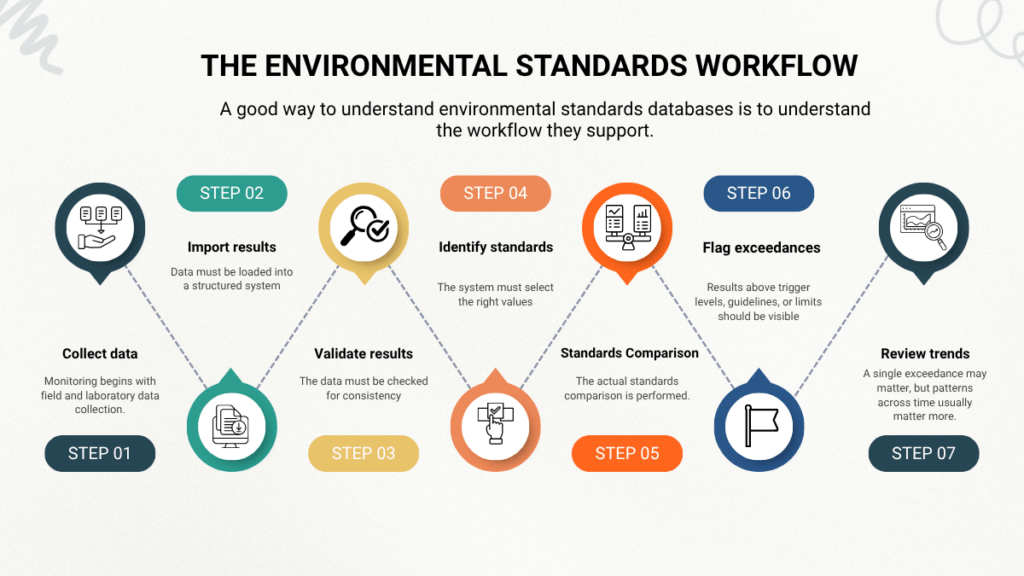
Collect data → Import results → Validate results → Identify applicable standards → Compare data against standards → Flag exceedances → Review trends → Report findings
This workflow turns raw environmental measurements into interpretable compliance information.
1. Collect data
Monitoring starts with field and laboratory data collection.
2. Import results
Results are loaded into a structured system, ideally with analytes, units, dates, matrices, and locations preserved accurately.
3. Validate results
Before comparison, the data should be checked for consistency and completeness.
4. Identify applicable standards
This is where the standards database becomes essential. The system must identify the correct threshold for the analyte, matrix, jurisdiction, and site context.
5. Compare data against standards
The actual standards comparison is then performed.
6. Flag exceedances
Results above guideline values or action levels should be visible immediately.
7. Review trends
Single exceedances matter, but longer-term patterns often matter more for environmental decision-making.
8. Report findings
The final output may go to project teams, clients, regulators, or public-facing reporting channels.
This workflow is one reason environmental standards databases are not merely reference lists. They are operational tools embedded in monitoring and reporting processes.
What makes a good environmental standards database?
Not all standards databases are equally useful. A good one should support the real complexity of environmental work.
Structured standards management
The database should clearly store source references, analytes, matrices, units, and conditions attached to each standard.
Jurisdiction support
Environmental organisations often work across different countries, states, provinces, or agencies. The standards system should support that reality.
Site-specific flexibility
Generic standards are not always sufficient. Site limits, licence conditions, and project-specific action levels should also be manageable.
Conditional logic
Some standards depend on pH, hardness, depth, matrix, or land use. A good standards system should be able to handle that without forcing teams into manual workarounds.
Version control and traceability
Users need to know which standard was used, when it was used, and whether it changed over time.
Exceedance identification
The database should not only store standards. It should support the identification of exceedances in tables, maps, graphs, dashboards, and reports.
Import and update capability
New standards should be easy to add, and outdated ones should be easy to revise without losing traceability.
Combined standards where needed
Some programs need one comparison framework that blends regulatory, corporate, and site-specific values. A strong system should support that.
In practical terms, a good environmental standards database should reduce the time spent searching, checking, and correcting standards logic, while improving consistency across projects and reports.
Why spreadsheets are a weak long-term standards database
Spreadsheets are understandable starting points. They are easy to create, easy to edit, and familiar to almost everyone.
But spreadsheets usually become weak long-term standards databases when teams need to manage:
- many analytes
- many matrices
- multiple jurisdictions
- conditional logic
- historical updates
- site-specific limits
- repeated reporting
- multiple users or teams
The risk is not just inefficiency. It is inconsistency.
Common spreadsheet problems include:
- outdated values still being used
- unclear source references
- unit mismatches
- duplicate standard sets
- hidden formulas
- manual copy-and-paste errors
- different project teams maintaining different versions
For small one-off checks, that may be manageable. For large, long-running, or regulated monitoring programs, it usually is not. This is why modern environmental data systems increasingly include environmental standards databases as core operational components.
Environmental Data Management: Spreadsheets vs Environmental Data Management Software (EDMS)
The Limitations of Spreadsheets in Managing Environmental Data
Environmental standards databases and compliance reporting
Environmental standards databases are tightly connected to environmental compliance software because standards are how compliance is often assessed in practice.
Without a structured standards framework, compliance reporting becomes harder because:
- exceedances may be missed
- wrong thresholds may be applied
- report preparation becomes slower
- outputs may vary across projects or teams
- historical comparisons may lose context
This becomes especially important when regulators request updated reports using revised guideline values or when internal governance requires defensible, repeatable reporting logic.
A good environmental standards database does not replace professional judgement, but it makes the data-to-decision workflow much more reliable.
Environmental standards databases and environmental data management software
An environmental standards database is often best understood as a core module inside environmental data management software.
That relationship matters because environmental data management software brings together:
- field data
- laboratory data
- logger and sensor data
- historical records
- standards
- analysis tools
- dashboards
- reports
The standards database provides the comparison logic that allows the monitoring data to be interpreted.
This is one reason platforms such as ESdat are relevant in this topic area. In ESdat, the standards database is not a detached reference list. It sits inside a wider environmental data management workflow that supports comparison, exceedance identification, analysis, and reporting.
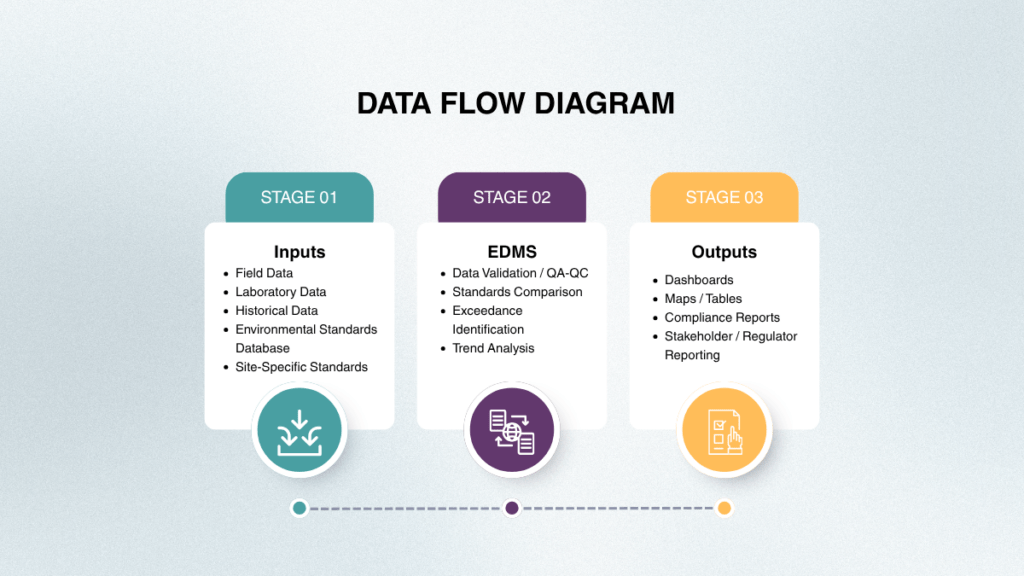
Figure 2: Environmental data and standards flowing into one environmental data management system for validation, comparison, analysis, and reporting.
Figure 2 shows how environmental monitoring data and environmental standards interact within an environmental data management system. Field data, laboratory results, historical records, and standards libraries are combined so that organisations can validate data, identify exceedances, analyse trends, and generate compliance reports more efficiently.
ESdat as an example of an environmental standards database in practice
A useful way to make this topic concrete is to look at a real software example.
ESdat is part of a wider environmental data management platform with its standards functionality included as a pre-compiled library of regulatory guidelines, support for user-added environmental standards and site limits, real-time exceedance alerts, and support for standards with pH, hardness, depth, and matrix dependencies.
ESdat has related standards workflows such as:
- uploading new standards from Excel-based templates
- associating standards with sites and locations
- combining multiple standards into one meta-standard
- managing complex action levels
- requesting additional regulatory standards
That makes ESdat a useful implementation example because it shows what a working environmental standards database looks like in practice: not just a static list of values, but a standards system embedded in monitoring, compliance, and reporting workflows.
ESdat: A Comprehensive Solution for Environmental Data Management
When is an environmental standards database used?
Environmental standards databases are used whenever monitoring results need to be interpreted against thresholds.
Common situations include:
- groundwater monitoring programs
- contaminated land investigations
- landfill compliance monitoring
- mine water and site monitoring
- wastewater and discharge reporting
- industrial emissions monitoring
- remediation progress tracking
- long-term site management
In all of these cases, the standards database is what turns measurements into meaning.
Related software categories
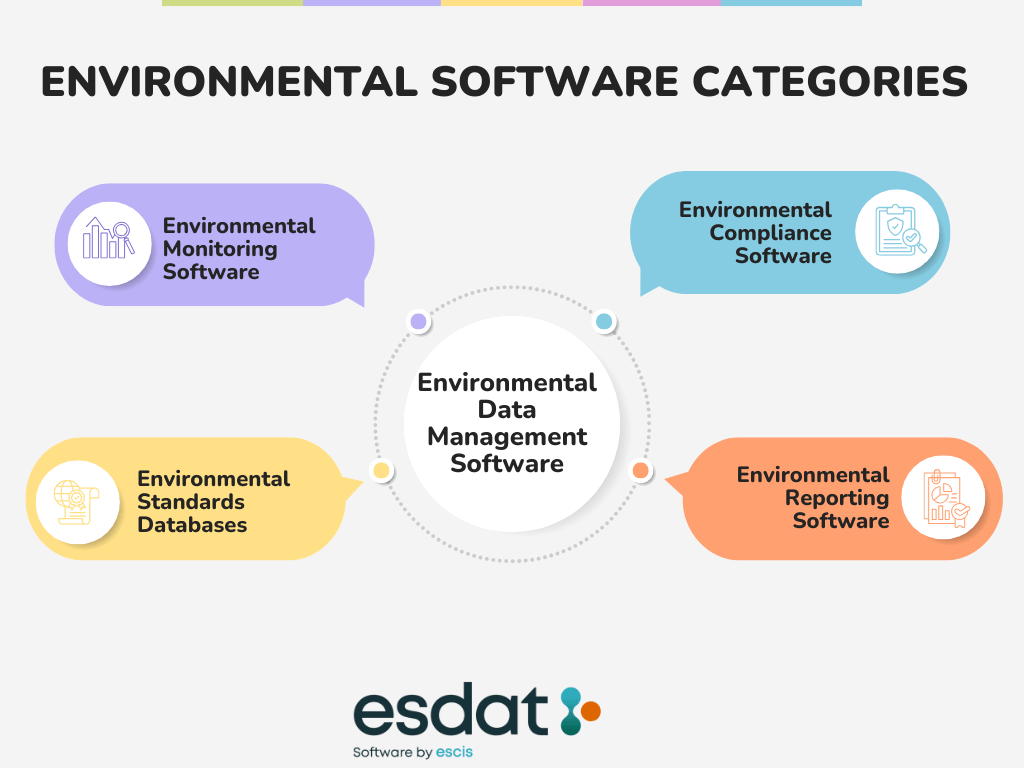
Environmental standards databases sit at the centre of several related software categories.
- Environmental data management software – the broader system that manages field data, lab data, standards, analysis, and reporting.
- Environmental monitoring software – the workflow layer used to manage monitoring rounds, locations, and results over time.
- Environmental compliance software – the compliance-facing layer used to identify exceedances and support regulatory reporting.
- Environmental reporting software – the outputs layer used to generate dashboards, reports, summaries, and stakeholder communication.
In practice, many modern systems combine these categories into one platform.
Glossary
- Environmental standards database
- A structured system for storing, organising, updating, and applying environmental thresholds such as guideline values, trigger values, and site-specific limits.
- Environmental guidelines database
- A database of guideline values and objectives published by regulators or technical bodies, often forming part of a wider environmental standards database.
- Groundwater standards comparison
- The process of comparing groundwater monitoring results against the correct applicable standards or trigger values.
- Exceedance
- A result that is above a guideline, standard, trigger value, or limit.
- Site-specific standard
- A location-specific or project-specific threshold used in place of, or in addition to, general regulatory values.
- Meta-standard
- A combined standards framework made from multiple underlying standards.
- Environmental compliance software
- Software used to assess monitoring data against regulatory obligations and support compliance reporting.
Frequently asked questions
What is an environmental standards database?
An environmental standards database is a structured repository of environmental thresholds used to compare monitoring data against guideline values, standards, trigger levels, or licence limits.
What is the difference between an environmental standards database and an environmental guidelines database?
An environmental guidelines database usually focuses on published guideline values, while an environmental standards database is often broader and may include site-specific standards, licence limits, trigger values, and combined standards frameworks.
Why is groundwater standards comparison important?
Groundwater monitoring programs are often long-running, multi-site, and highly regulated, so comparing results accurately against the right standards is essential for identifying exceedances and supporting reporting.
Can an environmental standards database include site-specific limits?
Yes. A strong standards system should allow site-specific standards, licence limits, and project-specific triggers to be managed alongside general regulatory standards.
Can multiple standards be combined?
Yes. Some systems support combined standards frameworks that bring together multiple underlying standards into one comparison set.
What software can be used for environmental standards comparison?
Environmental data management platforms can provide standards libraries, standards comparison, exceedance alerts, and reporting workflows in one system.
Final thoughts
Environmental standards databases are one of the most important but least clearly explained parts of environmental data management.
They matter because environmental data is not useful on its own. It becomes useful when it can be interpreted against the right standards, in the right context, at the right time.